

The struggle for balance is not working well so far…
The May 2025 Personal Income and Outlays report shows the consumer still spending with Disposable Personal Income growth (DPI) and Personal Consumption Expenditure growth in balance for the month. The savings rate was down to 3.0% in May and was flat to April (revised from 2.6% to 3.0%). Very low savings rates, high headline inflation, and rising consumer debt paints a picture of a stretched consumer sector.
The very weak personal consumption expenditure growth reported in the final 1Q26 GDP rolled into some spring relief with the release of the income and outlays data. For the PCE outlays data in May, the current dollar disposable income growth (0.7%) was in balance with the current dollar outlays (+0.7%). Both rose in May from April.
Getting into the weeds of the PCE price index, the headline of 4.1% and core PCE of 3.4% is closer to neutral or accommodation than restrictive given current fed funds rates. The PCE price index for the quarterly period of 1Q26 as reported in the GDP release this week saw the PCE price index tick slightly higher to +4.6% with the Core PCE price index for the quarter at +4.4%. The current inflation news is bad no matter how you want for forecast the other side of the Iran effects (see GDP 1Q26 Final: PCE Growth Plunge 6-25-26).
The MoM real DPI growth for May was +0.7% vs. -0.5% in April. DPI growth is good news for the household but also raises questions on the inflation pressure from the wage side in a market where real wages vs. CPI have been in the red vs. the monthly BLS data (see CPI May 2026: The 4% Rubicon 6-10-26).
Some highlights of PCE Price Index increases YoY include Energy Goods and Services at +24.3%, Goods at +4.8%, Nondurable Goods at +5.6%, Durable Goods at +3.3% and Services at +3.8%. PCE Services ex energy and housing was +3.9%.
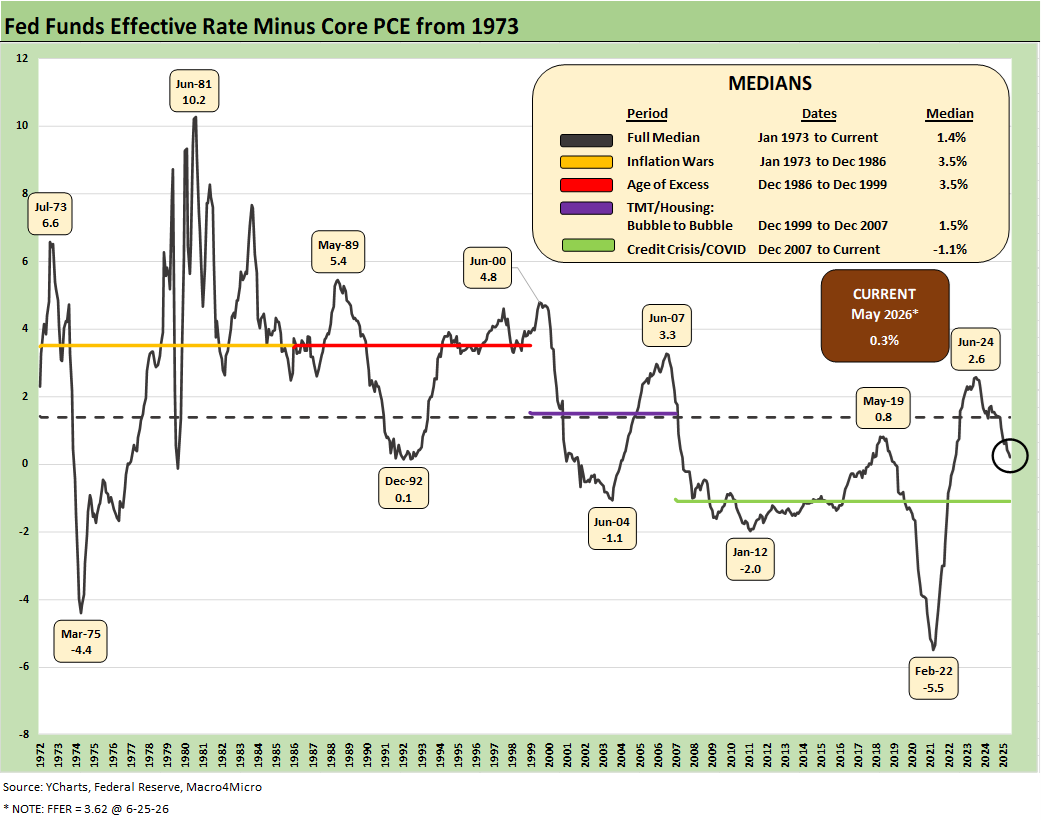
The above chart frames the timeline for “effective fed funds minus Core PCE.” For this latest May measure, we see the differential flat to April +0.3%. The level is well below the long-term median of 1.4%. If one sees inflation moving higher and demands from the White House to take rates lower, the economic class students could start wondering why they bother studying. Fed funds minus the headline PCE price index and CPI are already negative.
The Warsh wildcard has fallen aside quickly given the direction of inflation and fear that his buckling to Trump pressure could do some serious damage in a UST steepening reaction. Such a curve scenario could crush some tech equity valuations and also hammer housing even more in the 30Y mortgage reaction.
FedWatch odds of an FOMC easing by the Dec 2026 meeting has essentially been zero. The latest odds of 1 hike are 41.5% and no changes at 22.4%. We see 2 hikes at 27.5%, 3 hikes at 7.7%, and 4 hikes at 0.8%. Those odds will swing around with Iran, oil and inflation readings. The trend has generally been going badly for the easing scenario.
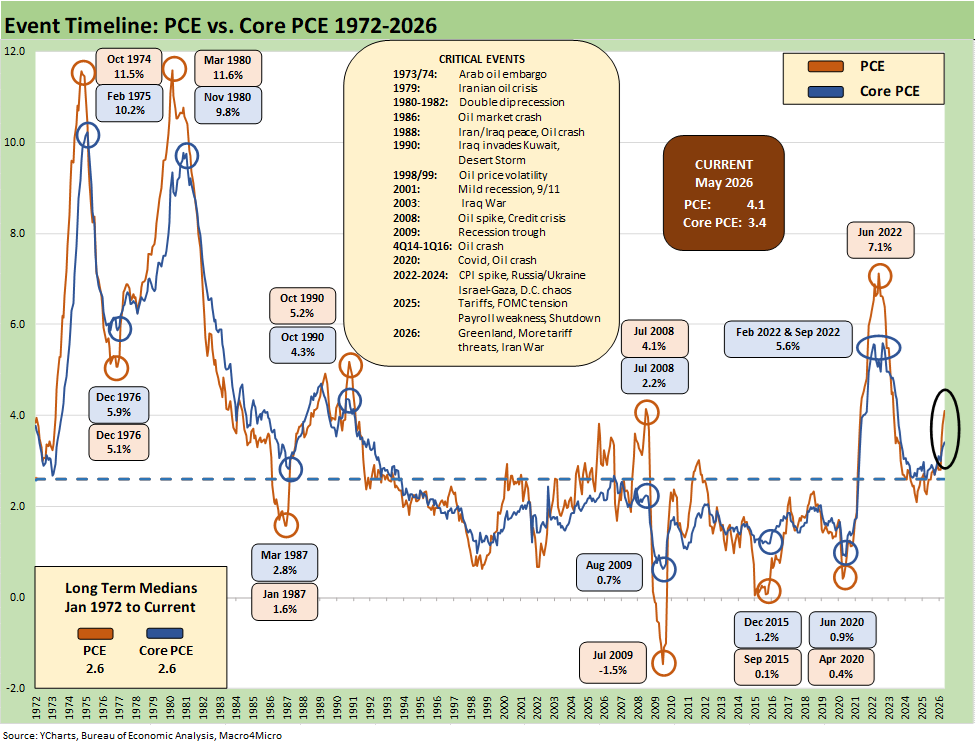
The above chart updates the long-term time series from 1972 for PCE vs. Core PCE across the decades and cycles. We see the 2.6% headline PCE long-term median in the lower left (well below the current 4.1% after 3.5% posted in April) and the 2.6% Core PCE median (vs. current 3.4%, up slightly from 3.3% in April).
That 4.1% headline PCE for May 2026 is dramatically better than where we came from in July 2022 at 7.1% PCE, but it is still well above the 2.0% target and going in a bad direction. In the context of 2025-2026, the headline PCE price index was 2.6% in Jan 2025 to start Trump 2.0 before the ensuing moves higher. Iran was the dagger and is flowing into a range of PPI, Goods, and Services lines as the effects reverberate. Oil and downstream effects are pervasive across the economy.
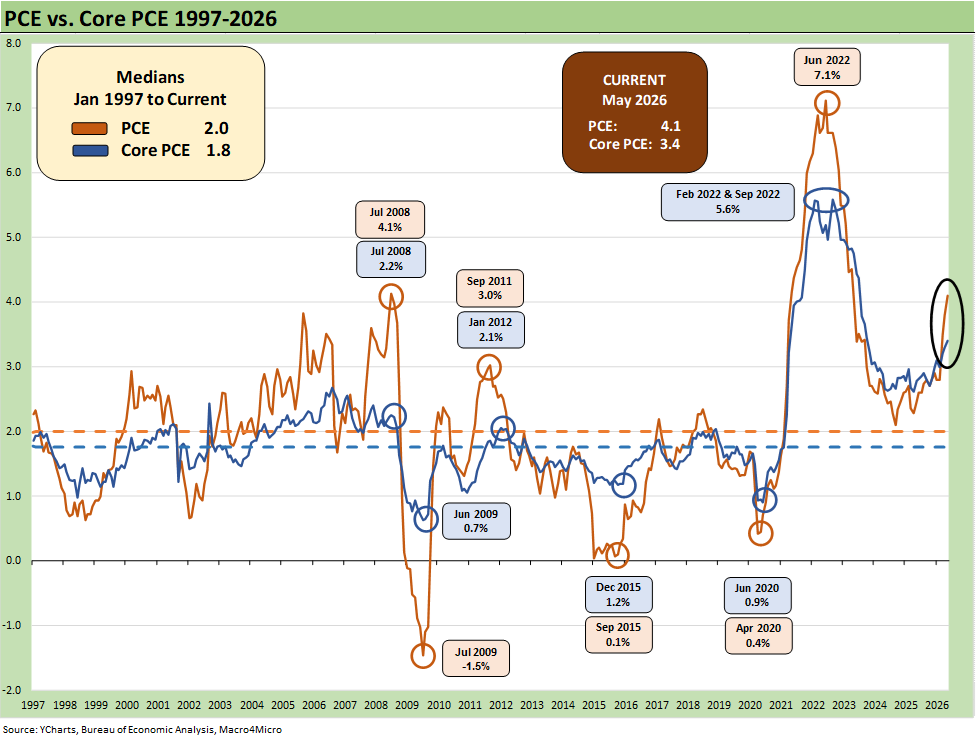
This is a replay slide that we use as a reminder on how the 2.0% target inflation rate frames up across the cycles.
We include the 1997-2026 timeline above as it offers a useful frame of reference on the PCE target of 2.0% that is routinely discussed by the Fed and in the markets. The shorter timeline from 1997 offers a better visual scale separate from the wild 1970s and 1980s. We will see what comes out of the Warsh working groups in their reviews of Fed policy.
The “1997 to 2026” period presents a rare stretch at or below the 2.0% PCE line and Core PCE median as noted in the chart. It took a lot to go wrong in that time horizon at the systemic level and in terms of macro shocks to cross below or at that 2.0% threshold. The events along the way included tech bubbles bursting in 2000-2001; oil crashes in the late 1990s and in the late 2014 to early 2016 period; and a bank system crisis from 2008 to 2011 (including sovereign stress) to get us there. The COVID pandemic in 2020 was a new one for the modern capital markets.
That gets us back to the debate over what is the correct formal inflation target or the “closet target” somewhere above 2%. There is not likely to be a formal change in the target, but the current backdrop would be missing it regardless and going in the wrong direction. Warsh cites what is to “left of the decimal” (i.e. “2” or “3”). As of now, he is at “4.” Warsh is sure leaving himself a lot of room even as he buys time.
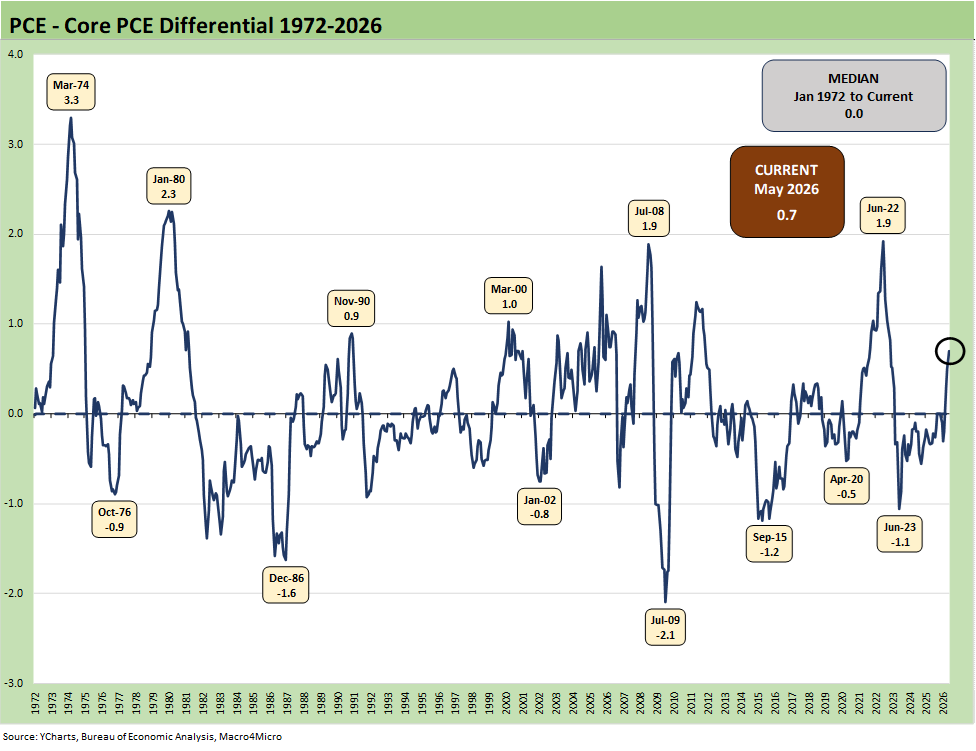
The above chart frames the long-term differential history between PCE and Core PCE since 1972. The long-term median differential is zero and we are currently at +0.7%. The volatility around that compressed long-term median ties into the energy wildcard with some food distortions also back in the 1970s.
We look at some of the CPI energy and food inflation moves in separate commentaries (see Inflation: The Grocery Price Thing vs. Energy 12-16-24, Inflation Timelines: Cyclical Histories, Key CPI Buckets11-20-23). Food and electricity inflation have been near the top of the affordability political rage-fest in this cycle. Households have been hit hard by energy costs (gasoline and electric bills and indirect impact of freight and operating costs rising in just about everything across food, goods and services).
The power demands of data centers are going to keep that energy and power line item in the headlines and notably as data centers get pushback in the states given power needs/costs and environmental effects. Life will get sticky in AI and the related ecosystem if the electricity topic cannot be addressed. The phrase “infrastructure bottlenecks” is getting tossed around a lot. That will impact valuation assumptions and pricing power questions.
Oil and refined products have joined in at this point, but there seems to be little interest from Team Trump to argue that the 2022 inflation spike was heavily influenced by the Russian invasion of Ukraine. That avoidance (evasion?) of the oil impact in 2022 as a major inflation driver crushes the credibility of the talking heads in the White House (Hassett, Bessent et al.). They can’t let on that Biden is not entirely to blame.
With an oil spike and uncertain direction of the Mideast war/ceasefire, the inflation history on the other side of such events is a very bad one. All we need to do is look back at late 1973-1974 (Arab Oil Embargo) and again in 1979 (The original “Iran oil crisis”) on the way into the 1980-1982 double dip. That crushed many mature manufacturing industries and led to wholesale restructuring alongside wide deregulation.
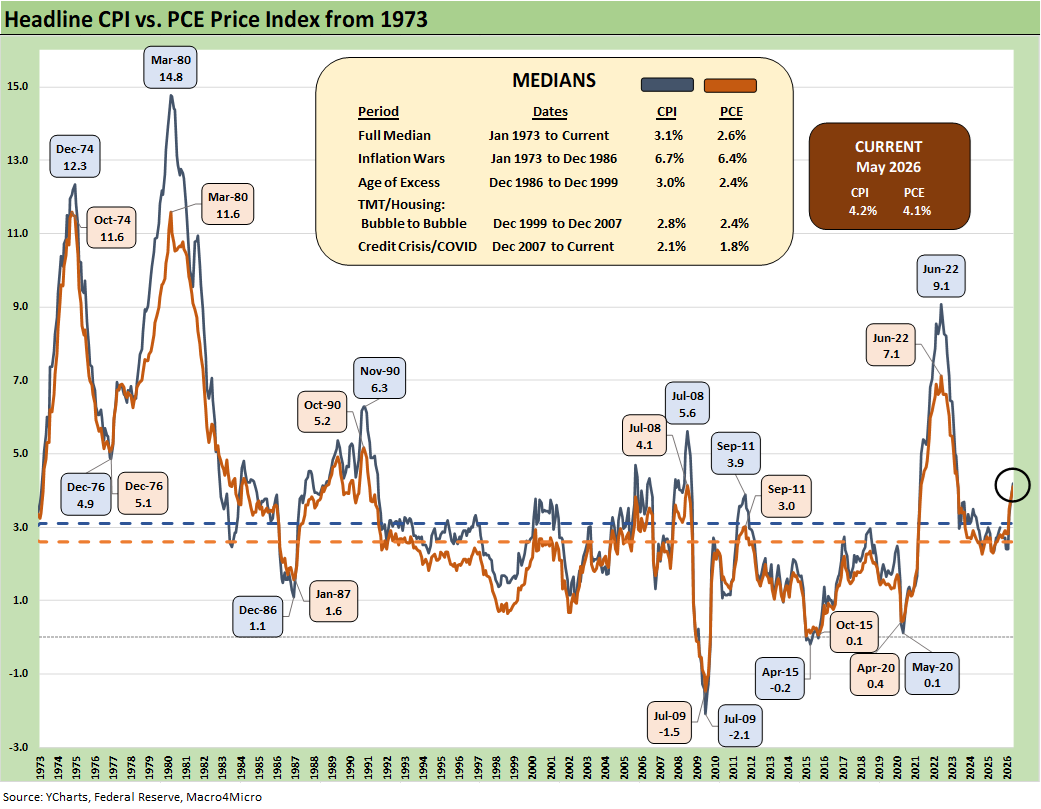
The above time series plots headline CPI vs PCE across time. The debates around which inflation metric is the best is something more for the faculty club types, but the above chart drives home how each has behaved across time.
“Higher or lower or stable?” is a good place to start regardless. Any investor should be aware of the line-item trends by product groupings. Relative weights are also useful to help guide the strategic reaction to headline and core inflation metrics.
Food and Energy is crucial for the consumer even if the monetary ideologues will carry on their views around inflation as narrowly defined in academic terms. The household experience with prices underscores that consumers care about household discretionary cash flow and how their take-home pay frames up vs. their household basket. “Derived metrics” in use such as CPI that do not match up with their own checkbook experience (owners’ equivalent rent, health insurance CPI, etc.) matter less to many. They care about the reality of increasing health insurance premiums or loss of health insurance, as well as the financing costs for their big-ticket purchases (e.g. autos, homes, boats, appliances etc.). Financing costs are not captured in CPI metrics for Goods.
The above chart is something of a “replay chart” we include in updates as a reminder that political theme-spinning out of Washington on economic cycles and inflation are usually stacked with selective memories, false statements (aka self-serving lies), material omissions, and conceptually anorexic story telling (like “seller pays the tariffs”).
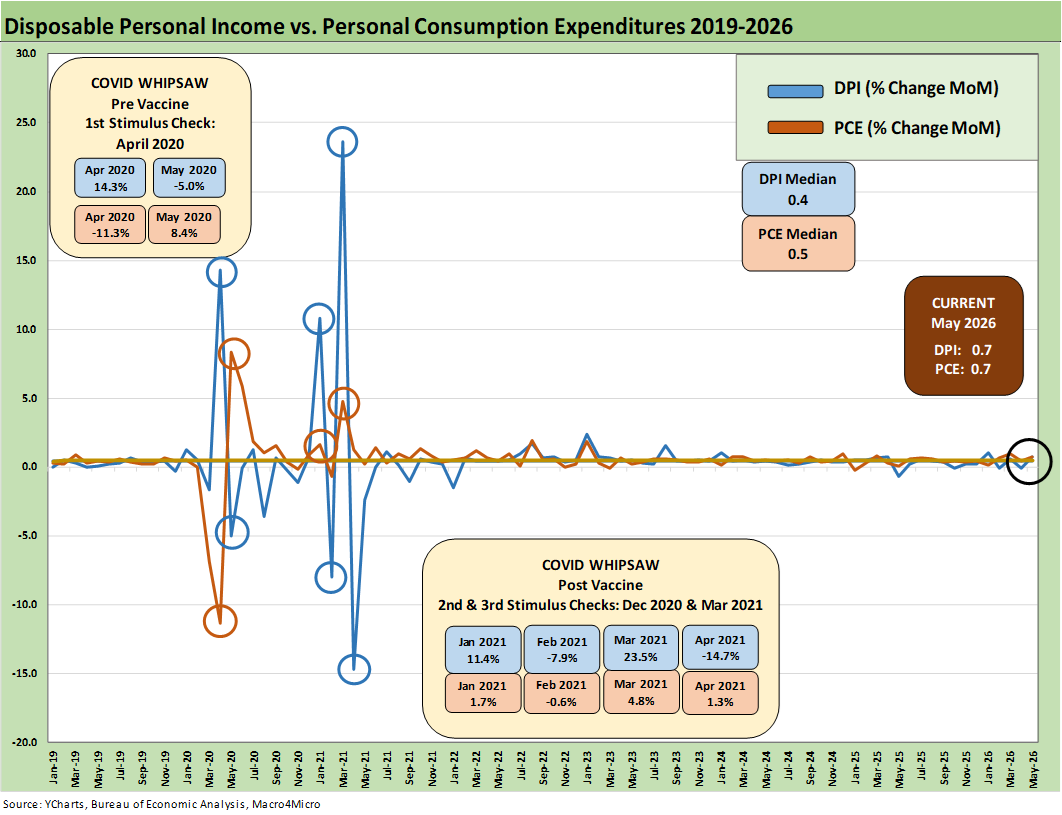
The above chart updates the trend line in disposable personal income (DPI) vs. personal consumption expenditures (PCE) that we get with each monthly PCE release. We like updating this chart each month to offer a reminder of what really happened given the waves of disinformation from the current administration. Revisionist history is one thing, but it is good to challenge gross falsehoods and misstatements with facts and history.
When PCE growth exceeds DPI growth (or negative DPI), as we see in April 2026 before leveling off in May, one conclusion is that many consumers are feeling good (i.e., ignore the sentiment metrics). Or perhaps they are tapping credit cards by necessity (e.g. the PCE could include outsized health care premiums put on their credit cards?).
We have been watching the rate of ACA dropouts and premium increases and shift to higher deductible plans. Health care is a mess and not clearly captured in the headline data. It all adds up to less cash flow at the household level, more borrowing (in some cases), and zero-sum effects on other outlays. Thus the softening PCE numbers in the GDP updates tell a story (see GDP 1Q26 Final: PCE Growth Plunge 6-25-26).
The stimulus overload of 2021…
Talking heads in Washington will “play pretend” around what happened in the “COVID tunnel and what unfolded coming out of that tunnel. That was a lot of structural imbalances and supply-demand dislocations.
The 2021 period was a big macro rebound in GDP off the COVID peak period. The strong macro backdrop in 2021 and heavy dose of fiscal accommodation did not mesh well with residual supply-side shortages in goods broadly as 2022 saw the end of ZIRP and a material inflation spike ensued.
Oil was a problem after the Putin invasion of Ukraine in late Feb 2022, and inflation hit a high in June 2022 at +9.1% for CPI as a headline grabber (headline PCE at +7.1% in June 2022) before the steady inflation slide to under 3% by the end of 2024. Core PCE had dueling peaks at +5.6% for Feb 2022 and Sept 2022.
Try to get Team Trump to even mention the oil price spike in 2022 as a factor in the 2022 CPI numbers. The questioning on the topic by mainstream media is also lame. The CNBC team does not push such Q&A since they are looking to take GOP interview share away from Bartiromo. They need to GOP to keep coming back. Tough questions don’t help that priority.
The COVID relief binge…
The above chart plots MoM Disposable Personal Income vs. PCE and offers a read on how wild things got during and right after the pandemic peak. This is a chart we use each month to revisit the DPI swings that came with the three COVID relief/stimulus packages. That included two COVID relief bills under Trump and one under Biden.
As a reminder, Trump signed the CARES Act in March 2020 (shows up in the DPI in April 2020) and Trump also signed the Dec 2020 legislation disbursed in Jan 2021 (Trump seldom mentions that Dec 2020 one since it is easier to blame Biden and Powell). Biden signed the America Rescue Plan (disbursed in March 2021) that was a demand pile-on (we would argue it was over the-top-stimulus) in a supply-constrained environment (thus inflation). The DPI and PCE wave tied to each of those shows up in the chart above.
As a reminder, the vaccine was announced in early Nov 2020 just ahead of two stimulus actions. That was soon to be a factor in PCE patterns and lag effects. The quarterly GDP numbers in 2021 on the post-COVID bounce were numbers generally not seen since the Reagan and Clinton years (see Presidential GDP Dance Off: Clinton vs. Trump 7-27-24, Presidential GDP Dance Off: Reagan vs. Trump 7-27-24).
COVID was a distinct period for supply chains and supply-demand imbalances. With tariffs and potential trade wars, it will remain important to look for similar imbalances whether in narrow product categories or in broad commodities and materials areas. We clearly face some now in the post-Iran period for oil and gas, refined products, fertilizers, aluminum, and numerous other inputs generating headlines (helium, sulfuric acid undermining copper production). Some shortages also undermine military readiness.
In terms of tariffs, the major trade partners have not initiated much in retaliation with the exception of a brief China spat. A “peace at all costs” strategy by the EU and USMCA partners has mitigated the damage, but that de facto submission could come back to haunt some major trade partners if others leaders run for office with a “get tough on Trump” election pitch. Caving in to Trump on tariffs is getting less popular in the EU and Canada. Trump is also pushing his luck after Iran in attacking allies.
Jacking up aluminum, steel, and copper on the materials side and seeking even more tariffs on lumber was not and is not a great idea for keeping prices and costs contained. Auto tariffs under Section 232 are extreme even after the array of “deals” and could go higher if the USMCA breaks down in 2026. Trump recently fired a shot across the EU’s bow aimed at German autos.
We saw semis, pharma, and aircraft/engines/parts added to the Section 232 pipeline although most of the aircraft/parts risk was mitigated in EU talks. Those EU talks are now in jeopardy again. Other actions brought in commercial vehicles, branded pharma, cabinets, and a range of targets on national security grounds including upholstered furniture.
The most important development in the tariff area was the SCOTUS decision on IEEPA. Trump has launching tariffs under Section 122 laws and initiating more Section 301 actions (unfair trade) to maximize his flexibility with Section 232 (national security) also in the playbook. He has already been hit with setbacks in court. Trump’s goal is tariff revenue maximization for his discretionary deployment and not economic efficiency.
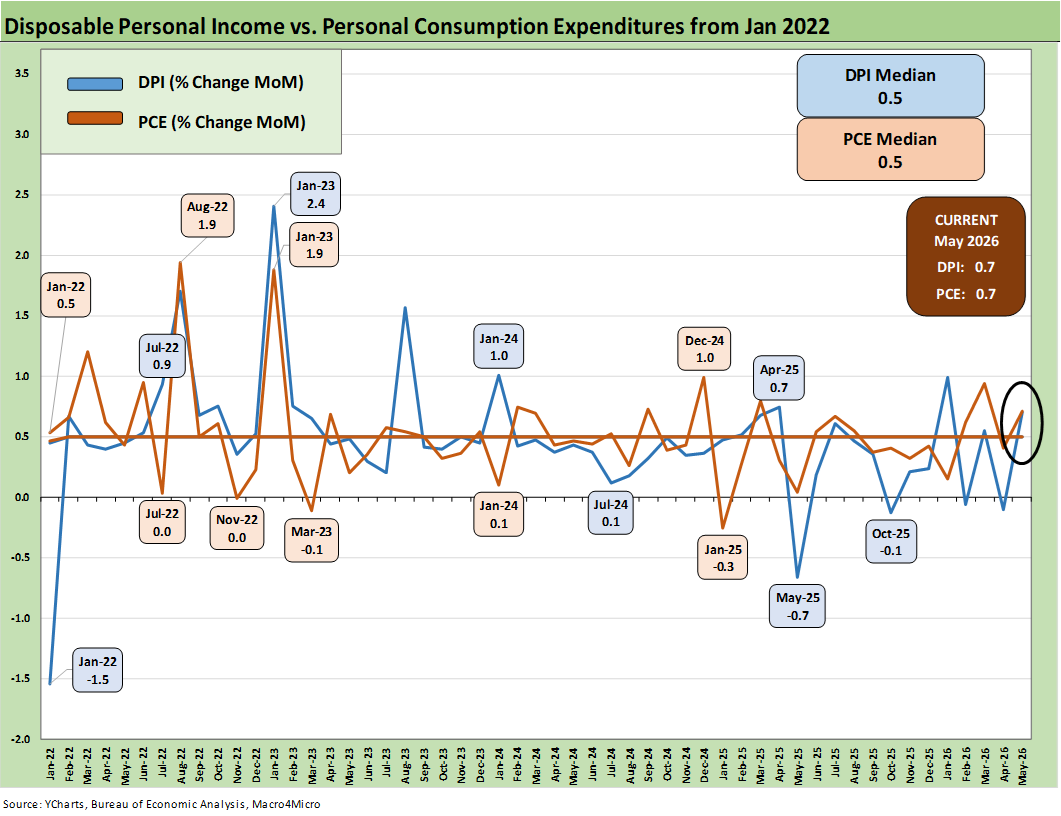
The above chart covers the time horizon for DPI vs. PCE from early 2022 as the tightening cycle kicked into gear after March 2022. Life in Jan 2022 was still quiet for Disposable Personal Income. We like to include this chart in the PCE updates just given the heavy mix of disinformation and politically axed story lines we constantly hear from Trump on Biden being the cause of all the macro problems even at the end of 2025 and into 2026.
Accurate factual and conceptual frameworks of “the now” matter more than qualitative political spin looking backwards. That said, having a sense of what the numbers were then helps clear up the misinformation nonsense. After all, this is a very different world of tariffs and top-down government policy with very different tax structures and priorities.
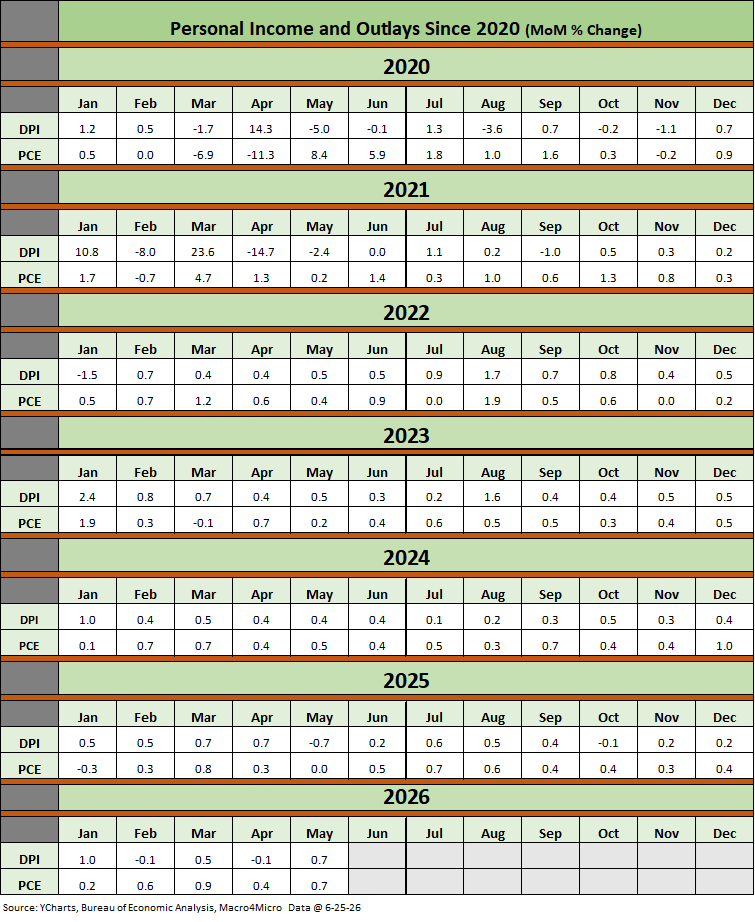
The above table plots the monthly Disposable Personal Income MoM change numbers vs. the Personal Consumption Expenditure MoM numbers across the years from 2020 through May 2026. It is an easy scan across key time periods for a look at turning points in DPI (e.g. stimulus payments) or PCE.
One exercise to do from time to time is to look at the table of reconciliation in the monthly PCE release for the granular dollar amounts on each DPI reconciliation line. The line items can sometimes show some volatility. We like to look for gaps between DPI and PCE and moves in Personal Savings.
It is always worth remembering that a tariff is a regressive tax that hits lower income consumers harder and the same for small businesses. The same is true in Medicaid costs based on the income brackets of Medicaid users. A loss of health care benefits and higher pharma costs present a zero-sum game with other consumption lines. As noted earlier, the current ACA premium spikes will also be a zero sum “game” for many budgets. Households have shifted to high-deductible plans or even ceased health care coverage entirely to “take their chances.” That is when consumers take on open-ended risk to medical care cost inflation.
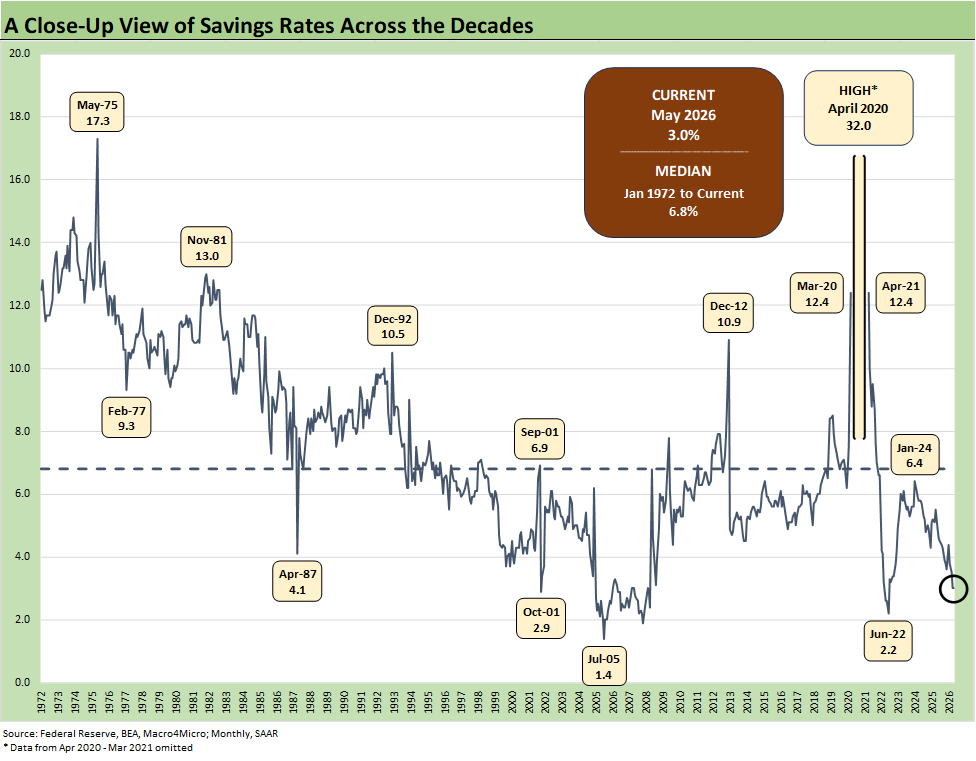
The above chart updates the running savings rate reconciliation that comes with the Personal Income and Outlays each month. We see a fresh low in May 2026 of 3.0%, flat to April (note: April was revised higher from 2.6% to 3.0%). The 3.0% is well below the April 2025 high of 5.5%.
The “Why?” of declining savings rates can be like a political Rorschach test on “buying on happiness” or “getting slammed on the prices of the household basket, tariffs and financing costs.”
The savings rate dipped below the 4% line in Oct 2025 and posted 3% handles and edged back above 4% for one month (Jan 2026). That savings rate decline can be a function of various forces, but the inflation trends (health care premiums, gasoline, home heating, and financing costs) and related household cash drain are eating more into real wages and the household bottom line.
See also:
New Home Sales May 2026: Weak Volumes, Stable(ish) Prices 6-25-26
GDP 1Q26 Final: PCE Growth Plunge 6-25-26
Trade Deficits: The Moving Parts and Macro Goals Matter Most 6-24-26
Market Commentary: Asset Returns 6-21-26
The FOMC Dance: Will Warsh and Trump Find a Rhythm? 6-17-26
Housing Starts May 2026: Weaker for both Single Family and Multifamily 6-16-26
Industrial Production May 2026: Steady, Balanced Utilization Levels 6-15-26
Geopolitical risk: Trump’s Nuclear Saber Rattling? 6-14-26
Producer Price Index May 2026: Too Many “Since 2022” References 6-11-26
CPI May 2026: The 4% Rubicon 6-10-26
Remembering D-Day: June 6, 1944
Employment May 2026: Big Rebound, Low Multiplier Bias 6-5-26
The Fall of CBS 6-3-26
JOLTS April 2026: A Modestly Positive Turn 6-2-26
Retail Signal Read Part Deux 6-1-26
Retail Equity Comps: Looking for Signals 5-26-26
Other inflation histories:
Inflation: The Grocery Price Thing vs. Energy 12-16-24
Inflation Timelines: Cyclical Histories, Key CPI Buckets11-20-23
Fed Funds – Inflation Differentials: Strange History 7-1-23
Fed Funds, CPI, and the Stairway to Where? 10-20-22