

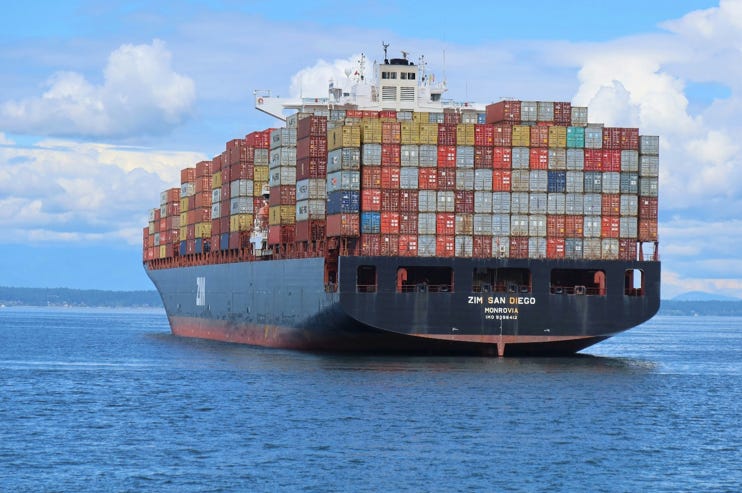
Do you want the contents to cost more or less?
We update the running YTD imports, exports, and goods trade balances with major trade partners. The “Blue Tsunami” raised important issues on what control of the House and Senate will mean for trade policy and whether the legislative branch will retake control of tariff oversight as the Constitution dictates (and SCOTUS reminded Trump with the IEEPA decision).
Will Congress make a move toward legislative clarity in its desire to be the rightful constitutional gatekeeper on tariffs? If so, what action can it take to claw back that tariff power and assure that the White House respects their legislative authority and stops going rogue while undermining the economics of many industries, businesses large and small, and hurting households?
Can Congress reassert its voice on tariffs to curb attacks on allies, win back some support in key swing states and in the South Texas Hispanic communities? Can they stop Trump from in effect creating his own tariff slush fund under management with Bessent and Treasury and assure that appropriate tariff levels are directed toward other priorities they decide on?
Will enough anti-tariff GOP leaders lose (or reduce) their fear of Trump threats in the lame duck home stretch as “affordability” leads the list of priorities for both Democrats and the GOP? Could enough GOP Senators (filibuster at 60 in Senate and veto override of 2/3 House and Senate) challenge the “whatever Trump wants” tariff policy with all-new legislation? Will they seek to step in front of the abuse of legacy statutes (notably Smoot Hawley, Section 232 “National Security” threats against NATO allies, and the highly subjective Section 301 tariff)?
Health care is arguably at the top of the priority list for Democrats, but that is a quagmire that will be a protracted battle. In contrast, tariff legislation could be simple in its ambitions, Example: “Any tariff above 10% must be approved by Congress.” They also could repeal the earlier legacy loopholes that give the White House a blank check for abuse.
If the GOP refuses to help, then there is another political weapon for 2028 that the GOP might like to avoid after the past election bloodbath. Being able to hold hearings and “force votes” and set the record by name makes a big difference. The process might even reinforce such seldom-heard statements as “the buyer writes the check for the tariff.” That is a fact that Trump still will not admit. He even has stated at points that the selling nation pays and that they got the IEEPA refunds. It is embarrassing.
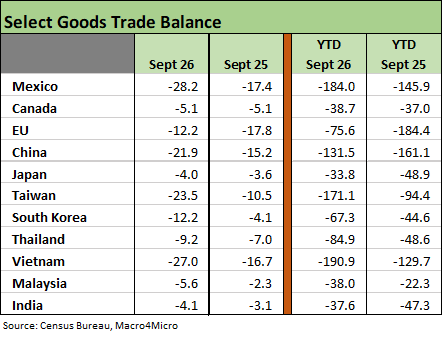
The above table updates the most recent trade deficit data for the September monthly goods trade deficit that gets released at a 1-month lag (release date 11-4-26, next release Dec 8). We include an abbreviated list of some critical major trade partners above. We include Mexico and Canada (legacy NAFTA and USMCA trade) and the EU as the top 3 trade partners (imports + exports).
As always, Asia is posting some very high deficits with the tech boom and the fact that demand is quite strong in the US economy. The irony is that a good economy (or good enough) leads to more supplies and goods being imported. The White House just says the “good economy” part.
The Asia connection and China/Taiwan risk factor…
We include some of the more important Asia trade partners. In terms of the goods trade deficits, Taiwan ranks third in the deficit rankings behind Vietnam and Mexico. Taiwan is the most critical and important trade partner in the “AI ecosystem” as well as in tech broadly. Taiwan is part of the “One China” policy, so it is always worth looking at both together. Those two tip the scales YTD with a $-302.6 bn YTD trade deficit.
When you consider the import mix from those two trade partners, they comprise a systemic threat to the “cost of sales line” and notably the tech supplier chain from chips to systems. That supplier chain reality covers many major US industries from the AI ecosystem to manufacturers to discount retailers and more. The rare earths and strategic materials risk hogs the headlines, but it is much more expansive all the way down to the “empty shelves” risk seen in the earlier Trump vs. China trade war. Retailers have low margins. They seek the lowest cost goods.
The partners formerly known as NAFTA…
Mexico and Canada will remain major focal points in the months ahead as Trump seeks to take action against Canada and Mexico. As a reminder, Mexico and Canada are 2 of the 3 largest trade partners. The legacy USMCA is in a state of flux, and the stakes are high in 2027.
This week Trump threatened to double tariffs on Mexico given a “caravan” in process. He is clearly itching for a fight. In looking for simple excuses for the election landslide, Trump and Vance blame Iran. We would argue tariffs played a big role. It is also easy to argue that the ICE violence and “masked man” abuse was a bigger factor in the Texas election than Iran and especially in the southern voting districts of TX. Trump just lost the Hispanic vote broadly.
Texas has major economic stakes in Mexico trade as well, so this is a more complex issue than some US companies wanting to raise prices. Mexico just edged ahead of the EU for the #1 total trade slot (imports + exports), but Mexico is #1 in imports as we discuss further below in the import section.
Canada has been a thorny issue and a constant target of Trump despite posting the lowest trade deficit of the major trade partners such as EU, Mexico, China, and Taiwan. The US posts a goods trade surplus with Canada ex-crude oil. Discounted heavy Canadian crudes are a much-desired feedstock by US refiners, so how is that a bad thing?
Trump has teed up more tariffs on Canada who – along with Mexico – should be getting a lot of focus from a new Congress. That trade uncertainty alone should be enough to get the Democrats and more courageous GOP House and Senate members (on the extinction or just endangered lists?) to lock in on tariffs early. If they cannot find some rational members for bipartisan action, they can forget about the rest since Trump will veto it all and then it is “on to 2028.” At least the forced votes will put them on record for what could end up as 2 years of lame duck trauma instead of addressing affordability and costs as the voters demanded.
Voters were not just voting on Iran…
With the new Congressional lineup and many in the GOP traditionally against tariffs, the opportunity for sweeping changes will be very much on the table if the GOP can find its courage and the Democrats are strategic in their approach.
Trump’s policies against Canada are especially unpopular in many key swing states (e.g. Michigan, Ohio, Pennsylvania). Even if state GOP leaders would do their “kowtow thing” on Trump trade policies, businesses and consumers were feeling the effects and worried about retaliation. Once again, see the election surveys. Corruption and affordability were priorities. Affordability is easier to address than corruption. The trick is finding the veto-proof vote count. A Senate filibuster-proof count would force Trump to go on record. That is at least political fodder for 2028.
Trump just saw the voters deliver a sweeping rejection of his policies across many states that he has carried in the past. Even Iowa joined the list. The same is true with Maine. Ohio had been viewed as reliably red. Not this time. Iowa, Ohio, and Maine have Canada as their #1 export market. Canada is also their #1 importer nation. That is an important factor that seemed to escape the White House (if anyone bothered to fill them in).
All the Asian partners in the chart play vital roles from semiconductors to components to integrated system assembly. Some of that overlaps with Mexico and the “low-cost labor arb” aspects of US-Mexico integrated trade flows. Mexico in total trade YTD (imports + exports) was #1 ahead of the EU, who saw a big decline in imports.
Asia clearly plays a massive role in the US tech boom and the capital markets “AI trade.” Asia shows some trade deficits such as Taiwan that make Trump’s trade themes look utterly ridiculous (“trade deficits are a cash loss.”) Those trade deficits fueled the AI boom that drives stock markets and a wave of favorable economic multiplier effects that bolstered GDP and stabilized job risks even if employment has been a mixed story (see Employment Oct 2026: Payroll Seems Strong but is only Median 11-9-26).
Keep it simple but not stupid…
The more I read about global supplier chains across the decades, the more incomprehensibly complex it appears to be when you get into the legal frameworks and intertwined economic risks (including currencies). The easier view of trade is that tariffs are a “cost” to importers that needs to be borne by someone, and it all flows into either prices and/or profits or offsets (e.g., headcount, capex, lower buybacks).
Tariffs also complicate the analysis of project economics and planning when time horizons extend beyond elections. That means erratic tariff rates and targets can have effects that are the opposite of the stated goal. We have covered that ad nauseum in past commentaries (see links at the bottom).
Emotions count…as the election hammered home.
The Trump trade rhetoric is especially ignorant or dishonest (or both?) in the case of Canada, where the goods trade deficit is in fact very low. As noted, the US posts a trade surplus ex-crude oil. Canada has been a target of Trump for years, and he would like to annex it for a reason. He is taking the Polk portrait on the Oval Office wall too seriously. Mexico is more contentious in terms of economics with low cost labor the overriding driver in many industries. That Mexico labor reality gets Bernie Sanders’ blood up also.
The audacity of Canada to stand up to Trump led to a wave of hostility intertwined with blatantly false statements devoid of factual or conceptual foundation. He also is hitting the racist/xenophobic anger reset button that is lately getting aimed at Mexico. We will see if more economically rational (and politically fearful) GOP members of Congress will take a hint from the Texas election disaster and dial it back.
While racism and ethnophobia was a more dominant set of factors, the Hispanic vote just fled with some South Texas districts swinging by over 70 points. Perhaps House members who want to keep their jobs and/or see their party get back in the majority can strike a deal with Democrats who want to keep their winnings. Both parties can try to support their case to voters on “affordability” by fighting tariffs.
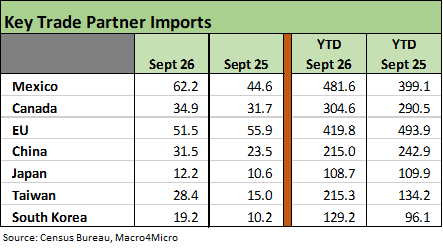
Import trends for Sept (month and YTD) are detailed above. We use a smaller group of major trade partners than in the trade balance chart. We see the legacy NAFTA/USMCA partners posting higher imports despite tariffs, which is in line with a stronger US economy in 2026 than 2025 and despite what has been a damaging set of tariff policies that are still being rolled in at a lag. We see the EU and China posting materially lower imports. Japan imports were down slightly. South Korea imports are materially higher and critical to the “tech trade.”
In contrast with China, Taiwan imports have soared. The always-lurking “One China” total (China + Taiwan) shows imports also higher on a pro forma basis. A Taiwan clash would be a dagger in the AI trade if geopolitics ever went off the rails (and off the ships). The tech supplier chains – and capital markets – are dependent on constructive, orderly, and peaceful relations with China. Trump is unlikely to challenge China too aggressively in the recent NVDIA topic. After all, what is a little honeypot espionage and IP theft between buddies (Trump and Xi that is).
The risk of China more aggressively asserting the One China policy with direct control of Taiwan trade is essentially the “non-nuclear, nuclear option.” That would send the markets into a brutal swoon. Where would that leave the AI ecosystem? It would be a good reason to avoid bad relations with China. And China knows it. When the China Hawks get noisy in Congress, it is not rooted in economic risk analysis.
On a YTD basis, China + Taiwan would be #2 behind Mexico in total imports and just above the EU in total imports. That is a lot of free market arm’s length decisions to influence via tariffs and White House interference in trade. Trump is big on “Who holds the cards?” When it comes to trade flows, China has a marked deck in its pocket. Whether chips in the gambling sense or the tech type, China will have more leverage in the future than it has now depending on how you view the Taiwan “One China” evolution.
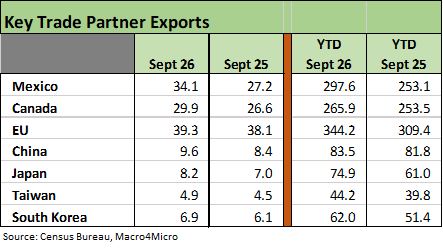
The trends in exports for the same group of 7 major trade partners are detailed above, and we see all 7 posting higher exports from the US YTD 2026. That is good news for the US, and each one has its own product segment mix that could include higher energy exports from the US (crude oil, LNG, and refined products).
Mexico always comes with the asterisk that many exports come back across the border in the form of imports. Some of the exports are thus “temporary” to take advantage of very low-cost labor. We have seen that in tech (especially in servers) and in autos and various component assembly for years. Labor costs in Mexico for various auto assembly plants are framed around $4 to $6 per hour.
Slapping more tariffs on Mexico if a new trade deal with Mexico gets derailed will lead to a fresh round of problems in costs and prices in the US. The more costs rise for a given product cycle, the lower US corporate margins will be or the higher prices will be for end market consumers.
The Trump election beatdown could embolden Mexico and Canada to keep pushing back just as many leaders in Congress could rediscover intellectual integrity (“buyer pays the tariff”). Some might even regrow a partial spine although a full spine might await 2029.
The fate of the USMCA trade partner relationships will need a lot of drilldowns and mind reading on the way into a radically overhauled Congress and how to gauge what the deep base of “tariff haters” in the GOP will do. There is also the mixed question of what the business community will support or demand. They may lack the same level of fear after Team Trump just got crushed. Many are also protectionist when it serves their pricing power (e.g. steel). That by itself is a statement in the affordability topic.
Trump’s noise level will remain high on trade (“Tariff is my favorite word”), but he is vulnerable on the tariff topic since his ability to make “real threats” to Congress now has many fewer to aim at as of January. The GOP stepping up on tariffs strikes us as more likely than health care given past rhetoric. The Democrats at least can force a vote.
While House members are perpetually running for office over 2-year cycles, many Senators with their 6-year terms can look beyond 2028. At last count, there are 18 GOP Senators up for reelection in 2028. Some might want to run on lower tariffs and their willingness to help small businesses and households.
Their voters spoke louder than Trump. Worrying about a primary should extend to worrying about being reelected in the first place. Democratic Senators exposed to “flipping” from blue to red would also be served by highlighting something in the affordability realm. For many, tariffs are easier to understand in 2026-2027 than in 2024. They also can be reminded they were lied to on the topic (by Trump, Bessent, Lutnick and Navarro) on how tariffs work.
Trump’s lameness as a duck might be quacking at a lower volume by 2028. For now, it just got louder in his post-election depression stage. The new leaders take the gavel in January. There will be plenty of Democratic candidates who would love to run on the “other guy” not supporting lower costs. The GOP could mitigate that risk with actions on tariffs.
The Democrats may squander a good opportunity (it’s a thing they do), but the opportunity is there. Tariffs are a good target. Reversing the Big Ugly Bill health care provisions could get pureed into “Medicare for all” debates, and the topic flows into 2028. Take the tariff win. If they can’t do tariffs, health care is not happening.
Breaking the ice on anyone in the GOP standing up to Trump on tariffs could be encouraging. The idea is Trump does not have “the juice” to end careers like he did with GOP Senators such as Toomey (PA) and Corker (TN) on their tariff views. They had brains and courage. That combination of traits was disqualifying for the Team Trump crowd back then.
Tariff and Trade Commentaries:
2025 trade Deficits: Reality vs. Rhetoric 2-19-26
Switzerland-US Trade: A Deficit that Glitters 2-3-26
US-Taiwan Trade: Risks Behind the Curtain 2-1-26
Trade Deficits: Math Challenge 1-30-26
China Trade: Shrinkage Report 1-28-26
Mexico Trade: Gearing up for More Trade Trouble? 1-27-26
Canada-US Trade: Trump Attack N+1 1-25-26
US-Canada Trade: 35% Tariff Warning 7-11-25
India Tariffs: Changing the Music? 7-11-25
Taiwan: Tariffs and “What is an ally?” 7-10-25
Tariff Man Meets Lord Jim 7-8-25
South Korea Tariffs: Just Don’t Hit Back? 7-8-25
Japan: Ally Attack? Risk Free? 7-7-25
US-Vietnam Trade: History has its Moments 7-5-25