


The pitch on trade and the FOMC is moving slowly and unpredictably.
The focal point for UST markets in gauging FOMC moves is typically inflation and jobs. The exercise also looks at wage trends (currently painfully low) and supply-demand conditions which are currently constructive except for commodity inflation (esp. Iran and oil) and tariffs. Economically supportive payroll numbers were seen last week with PPI and CPI due this week. The overhyped payroll beat came in slightly below the post-Jan 2009 median but still was better news than the alternative. With jobs, Warsh has one less excuse to pause and wait a month from the Sept (15-16th) for the Oct (27-28th) meeting (see Payroll Aug 2026: Trouncing Low Expectations is “Positive” with an Asterisk 9-5-26).
As we go to print, the odds of 1 hike for Sept stand at 60.4%. The odds of 2 hikes (400-425 bps range) by the Dec 2026 meeting are now 36.7%. The question is whether a median-level jobs month can alter views of more FOMC members away from hawk mode and wait for more data (see Payroll Aug 2026: Trouncing Low Expectations is “Positive” with an Asterisk 9-5-26).
In the realm of the irrational, Trump’s threat to end all trade with any trade partner with a trade surplus if the FOMC does not ease defies printable adjectives. Just about every major trade partner including the EU, Mexico, Canada, China, and Taiwan would be in that bucket. The fact that Canada is a massive oil producer and resource exporter to the US saw the relatively small Canada goods trade surplus remain somewhat stable YoY through July 2026 to $28.2 billion. That includes ~$56.3 bn in crude oil and a lot of resources the US needs.
If Trump attacks all major surpluses, he must really hate Taiwan, who has seen its trade surplus spike to $127.8 bn through July 2026 from $70.8 bn. That would be a dangerous one that he seldom speaks to. The stock market and AI ecosystem would simply love him using that deficit as an example (he would not dare). Cutting off trade with Canada is impossible given the US resource needs and inflation threats to refined products and fertilizer (and thus food prices).
Taiwan and Canada offer a reminder that there are often very good reasons for trade deficits. Of course, Trump still claims the “seller pays” the tariff, so reality is on a different plane than Trump’s thought patterns. Concept-lite and fact-free is not great for policy consistency as companies try to frame where to commit capex for longer term projects. There will be no Congressional legislative check even if the Democrats sweep the Senate and House. Just a lot of hearings.
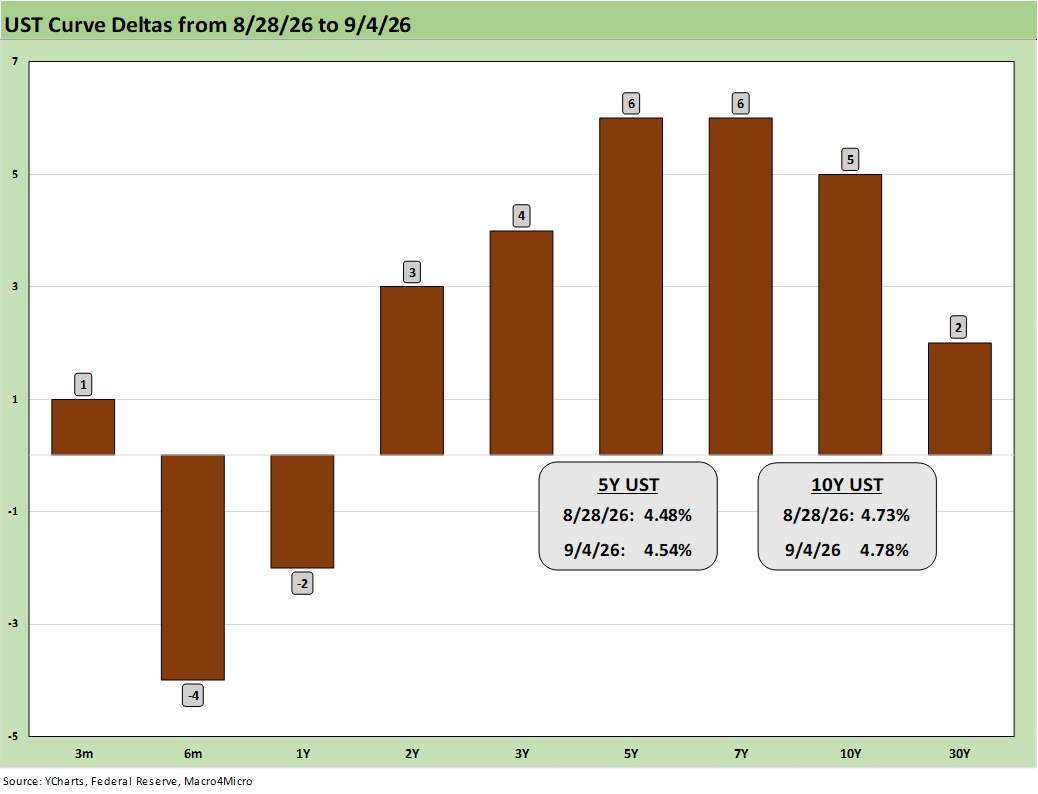
For the week, we see a slight UST steepener from 2Y UST to 10Y with a lot of action to come this week with CPI and PPI. We will also get more shrill commentary from the White House ahead of the following week’s FOMC action. The start of Canada tariffs will get a response from the White House and twice the usual number of AI generated imagery (this weekend was especially crazy and extremely militaristic and threatening to the world).
The weekly UST deltas were remarkably unexciting considering the level of noise and heightened pressure on FOMC from Trump and Vance along with the attempts by Bessent to execute on his homegrown shapeshifting strategy out the curve. He has also joined the schoolyard insult game to please Trump when he should be rising above that fray.
Over the weekend, Trump has now waded back into the currency topic with an attack on Canada. That was featured in the trade noise of Trump 1.0 when competitive devaluations were the hot topic. Back then (2017), Navarro was swerving way outside his lane by attacking the euro valuation and Germany with its trade surplus (YTD July 2026 trade surplus by Germany of -$36.9 bn).
Back in Trump 1.0, Navarro cited the weak euro vs. the dollar and a distorted “implied deutschemark” exchange rate. Team Trump appears to be rolling that one out for Canada. Trump also opens a fresh door for Bessent to walk through if Trump stays on the topic. At some point, more of the targeted trade partners will scale back UST holdings. Team Trump can at least celebrate a victory by “fellow travelers” AfD in a state level election.
In a back-to-the-future moment, we now are seeing Argentina rattling its saber around the Falklands again (flash back to Reagan 1.0 in 1982). Trump is supposed to weigh in, so we could see another major European and NATO “ally” clash with the US. Since Trump and his “Donroe” doctrine took wing, this could be one more catalyst for trouble with NATO allies and major UST holders. The UK is outside the EU, so Trump’s ability to wave the tariff flag more narrowly at the UK is a risk if Trump is spoiling for an “Argentina beef” with the UK.
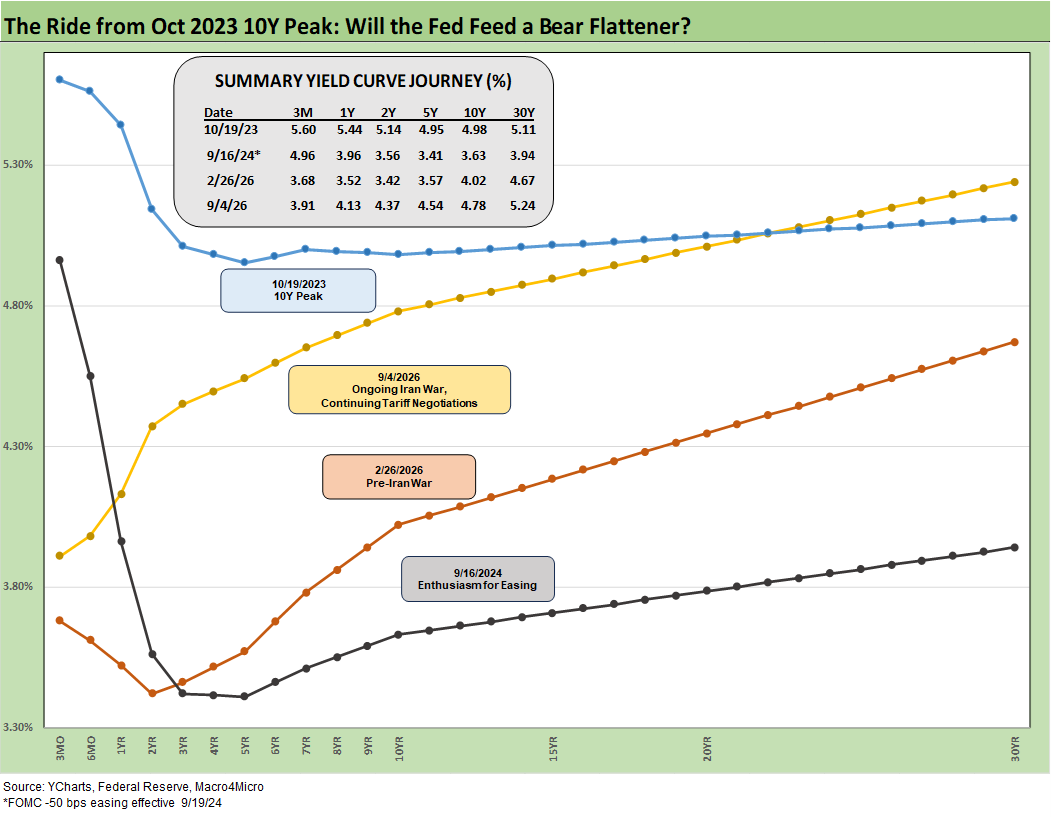
The above chart updates the UST migration from the start of the easing cycle after mid-Sept 2024 up through the pre-Iran curve, and then on into the latest round of inflation and steepening. We detail the yields in the box, and the recent moves are edging toward the Oct 2023 highs on the 10Y.
That Oct 2023 period is a crucial focal point given the peak cyclical mortgage rates that briefly hit 8% in some surveys (see Sept Existing Home Sales: The 7% Solution Running Low 10-19-23). As of Friday, the Mortgage News Daily survey stood at 6.89%. The 10Y UST is only around 20 bps from the Oct 2023 highs, so the housing sector is still in harm’s way subject to any adjustments in mortgage spreads. Iran military action over the weekend remains a wildcard that does not look to go away.
See also:
Payroll Aug 2026: Trouncing Low Expectations is “Positive” with an Asterisk 9-5-26
Market Commentary: Asset Returns 8-31-26
Market Commentary: The Curve 8-30-26
PCE July 2026: Mixed Consumption, Stubborn Inflation 8-26-26
2Q26 GDP: 2nd Estimate 8-26-26
New Home Sales July 2026 8-25-26
US-Canada: Benches Ready to Clear 8-22-26