

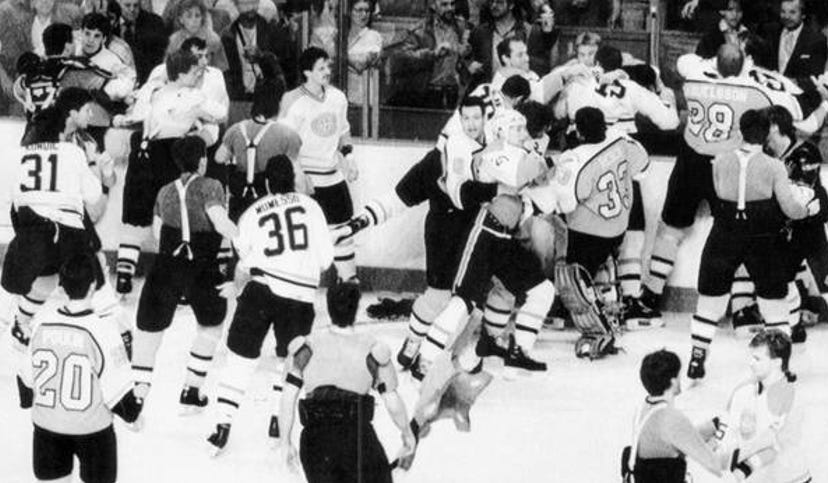
Flyers vs. Montreal Canadiens Pregame Brawl (1987): Business Model for Trade?
The Friday stroke of midnight came a few minutes after the headlines came out that there was no deal. The 50% tariff attack on Canada is now underway, and the crisis assessment and risk handicapping kicks into gear.
As seen in his Iran negotiations, Trump is big on “unconditional surrender” (How is that working out?), and the 11th hour change to the US-Canada tariff talks apparently took on the same tone very late in the process. We try to summarize some of the color from Saturday morning and afternoon reports from Canadian leaders and media north of the border. Canadian Broadcasting Corp (CBC) was jammed with activity.
Team Trump’s negotiating stunts sought to destroy the economics of the GM and Ford heavy duty pickup plants in Canada. The adjustments reportedly were tied to Lutnick’s desire as the Head of Commerce to crush the auto sector in Canada and reduce the Canadian auto industry to “components only.” The last minute tariff adjustments left heavy duty pickup trucks vulnerable as peak tariff targets.
The real dagger in the deal was Team Trump’s repeated effort to gain more control over sovereign rights of Canada from minerals rights to trade partner decisions. That included US demands for Canada to target undisclosed nations for tariffs. In the end, Team Trump behavior was showing more signs of a 51st state annexation end game.
Among the rumored provisions added late in the game was an option for Trump to gain a free tariff hand essentially any time he wanted to snap back to 338 or 301 tariffs. There will naturally be finger pointing from both sides and a wave of misinformation, but the credibility contest is a tad one-sided in this case.
Where did Trump encroach on sovereignty of Canada?
Among the items that Carney covered in his prepared statements and Q&A was that the late changes attempted and some pursued across the process that entailed material encroachments on Canadian sovereignty. Such efforts would necessarily be a deal breaker for a major NATO partner and G7 member.
The risks are not helped by the perception of Trump as a troubled mind at the helm of the largest economy in the world who has demonstrated excitement about deploying an increasingly threatening military strategy (in more than 1 hemisphere). A massive annexation genie was released to start Trump 2.0, and that empirical evidence is staring Carney in the face.
Sovereign encroachment was naturally going to get intense focus as Carney and the provincial leaders framed the behavior of someone who threatened “economic coercion” of Canada and “51st state” ambitions. Trump used the words “arbitrary borders” between the US and Canada while discussing the use of military force in the Panama Canal and Greenland in the same conversation back in Jan 2025.
A few of the more outrageous sovereign violations pitched early and late in the process appear to include:
The US gaining first claims on Canada mineral rights and ability to step in front of other outside interests. That was a “NO!”
Proposing terms that limit or restrict future trade deals. That was a “NO!”
Derailing Canada’s cultural protections (media, labeling, contracts, languages, French, etc.). That was a “HELL NO”
The late change of terms for the heavy duty pickup tariffs was a change that was more sea level and industry based, but it was a late game maneuver and not good faith timing. The reported documentation games included a “snap back” provision on tariffs (aka “Trump can do whatever he wants any time he wants”). That obviously raised some level of distrust given that Trump has violated all the trade deals with Canada already.
We do not have the full monte on sovereign violations proposed and there likely were some that likely wanted to “put Canada in a box” in tech that could be controlled by US interests (AI choices?).
Why would Canada respond with retaliatory tariffs?
Retaliation and “dollar for dollar” tariffs is more about economics than emotion and revenge. The emotion sometimes obscures the fact that unit costs for Canadian products on the US side rise, and that gives the US sellers an intrinsic price and cost advantage. At 50%, the cost is a mismatch that is more an economic wall. Canada needs to respond on the Canadian side of the border with tariffs on US products, so the Canadian sellers have a similar advantage vs. US competitors. That is to establish a level playing field for Canada even if Trump’s shameless “trade rep mouthpiece” says otherwise. It is basic cost accounting.
The playing field cost leveling is especially important in a market such as steel and fabricated metal products with more commoditization. For aluminum, Canada has a massive low-cost power advantage, but Trump’s tariffs raise those costs for US buyers and can be used to encourage US investment in aluminum (but that won’t happen). The power cost is prohibitive and projects take years, so it just ends up as a Treasury revenue and economic damage to buyers of aluminum.
US export targets to Canada…
If you look at the historical mix of US exports to Canada, we see high value-added line items and arguably a mix that is the best of all the trade partners (see links at the bottom). Canada has a lot of targets to aim at. That could benefit other international sellers of products from the EU and Asia that could undermine US sellers even if Canada cannot compete. That is one more risk for US manufacturers. Canada can essentially seek out other substitute imports away from the US.
Can’t fight the tide and the wave of cowardice…
In the end, the anticipated trade deal tanked given the expected behavior of an unchecked wannabe trade dictator with no input from Congress. The recent use of Section 338 from the Smoot Hawley Tariff Act of 1930 gives Trump unbridled flexibility until some court decisions hopefully check that. Meanwhile, Section 301 tariffs using the “forced labor” rationale have also been in the Trump playbook.
The checks on Trump remain MIA. The Senate sheep herd just sits, and the House is not even worth mentioning. They cannot change any laws regardless since Trump would veto them and it probably could not get past filibuster in the Senate. We will see how this ugly period plays out when we see Trump full range of rage posts and tariff counters. Sept 8 is the date for the Canadian tariffs to go into effect.
Canada Tariff Commentaries:
US-Canada Tariffs: Protection Racket 4-19-26
Canada-US Trade: Trump Attack N+1 1-25-26
US-Canada Trade: 35% Tariff Warning 7-11-25
Tariffs: Amazon and Canada Add to the Drama 4-29-25
Trade Exposure: US-Canada Import/Export Mix 2024 2-7-25
Aluminum and Steel Tariffs: The Target is Canada 2-10-25
US Trade with the World: Import and Export Mix 2-6-25
The Trade Picture: Facts to Respect, Topics to Ponder 2-6-25
Tariffs: Questions to Ponder, Part 1 2-2-25
US-Canada: Tariffs Now More than a Negotiating Tactic 1-9-25
Tariff: Target Updates – Canada 11-26-24
Trump, Trade, and Tariffs: Northern Exposure, Canada Risk 10-25-24
Trump at Economic Club of Chicago: Thoughts on Autos 10-17-24