


This could hurt a little.
We don’t expect an overly aggressive FOMC would rival Doctor Giggles (above: RFK Jr advisor) for inflicting pain, but the challenges facing the FOMC remain clear. The lag effects of energy price spikes, extensive tariffs, and unfriendly commodity costs will flow into margins and/or pricing decisions. The steady demand from the high level of fixed investment and a consumer that (so far) just will not quit makes for very stubborn inflation scenarios.
The bias higher on the front end of the curve from the Fed and the roll-the-dice nature of geopolitics and how that flows into oil and the long end of the UST curve will keep the heat on financing costs. Mortgage rates and more expensive consumer durables financing can strain debt service affordability - notably in housing.
Earlier this week, markets saw sharply lower UST rates even as inflation was rising and stocks selling off as scenario spinning ran from flight to quality to more bearish growth anxiety to more chatter of “too far, too fast and too high” on AI ecosystem valuation.
Waves of earnings and guidance ahead should calm nerves, but inflation has been the hardest variable for rays of hope as many lines have been going the wrong way. PPI was downright ugly today after the CPI release yesterday drove some market reactions along the UST that blurred asset class risks and prompted some repositioning with some seeing flight to quality (see Macro Crosscurrents Rattle the UST Curve and Equity Valuations 10-15-26).

The above table details the customized special aggregate CPI indexes posted in Table 3 of the BLS release. Our favorite special aggregate is “All Items less shelter,” and we see that rise to 4.0%, which is the highest since 2022 and well above the 1% handles of 2024. Those other aggregates detailed include some other useful metrics, but there is a long list worth reviewing on Table 3. Nondurables over 6% CPI and the Services lines over 3% are not helping the story given their index weightings.
Note: We had to be selective in the months included in the table to show more of the timeline. May 2026 (not shown) was an especially challenging month (see CPI May 2026: The 4% Rubicon 6-10-26).
The reality is that headline inflation of 3.7% translates into real hourly average wages in the red zone. That is a negative factor by definition.
If you drive to work in what is a “driving country” like the US, the 3% handle wage growth we see each month (3.0% in Sept) does not frame up well vs. 34.2% YoY gasoline inflation, 4.4% electricity, or 5.0% utility (piped) gas. Meanwhile, home heating oil has spiked in areas such as the northeast where home heating oil has a large share.
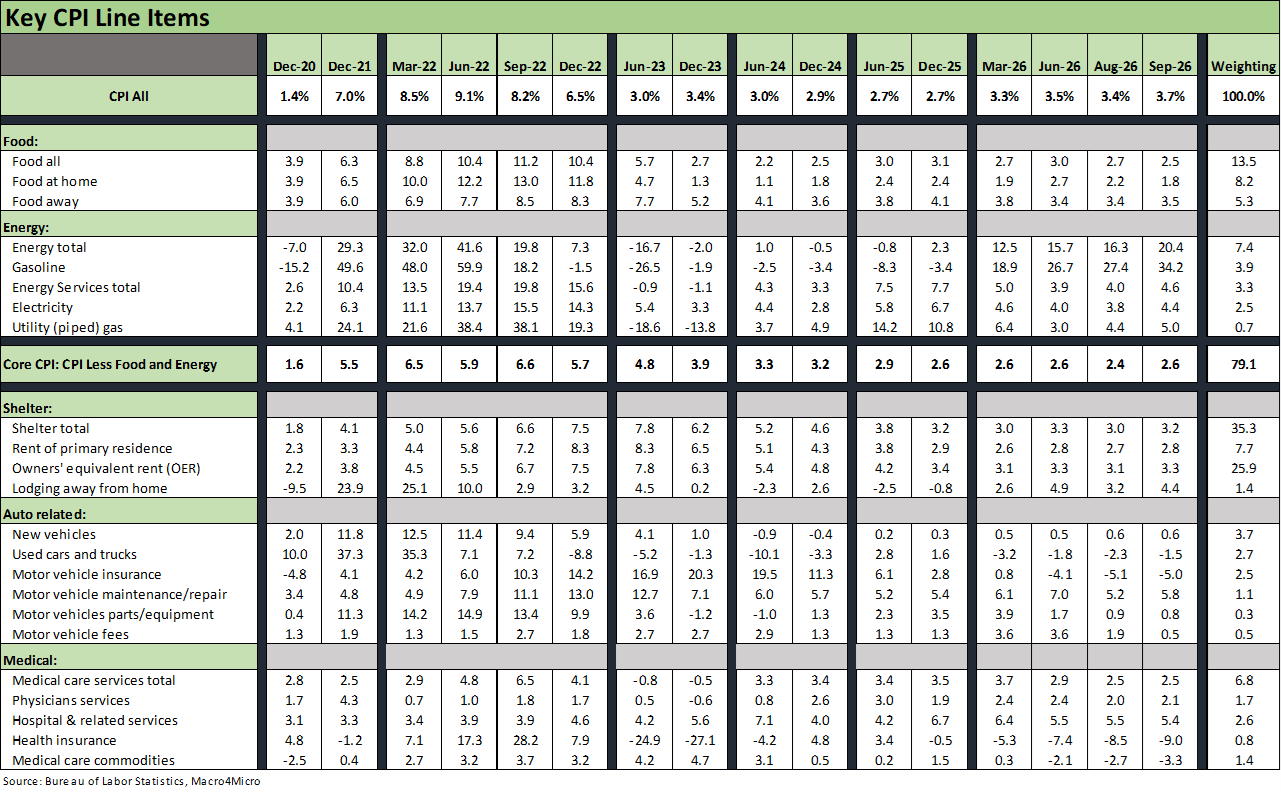
The above table details our Big 5 subsectors for CPI. These roll up to around 75% of the CPI index, so overall this mix of 5 broad categories is the main event even if there are plenty of line items outside this group that matter to consumers.
Energy has been the dagger in 2026 with Sept posting 20.4% YoY, up from 16.3% in August. Gasoline hit 34.2% in Sept, up from 27.4% in August. The sequential MoM move in Energy was still +5.2% in Sept with gasoline at +9.1% for the month and 34.2% YoY.
Medical care was a mixed bag this month for total medical services at +2.5%, but Hospital Services CPI remains above 5%. In broader health care sector context, the dollar pain of deductibles in coverage are getting worse along with premiums. This is not captured properly—by any stretch—by CPI.
The asterisk lines…
Some of these CPI metrics face some major questions around the utility of the “derived” nature and theoretical foundations that bear little resemblance to household cash flow reality. As noted, Health Insurance as defined by the BLS is in major deflation mode at -9.0%. That clearly has little to do with the crippling consumer experience in health care premiums and deductibles.
As we have covered in the past, the least useful derived CPI metric relative to its high weighting in the CPI index is Owners’ Equivalent Rent (OER). The cash payments each month are dominated by the mortgage payments and various costs of operating the house (suppliers, utilities, etc.). Where “affordability” is under strain is the monthly mortgage costs associated with buying a home.
The dominant barrier – whether existing home sales or new homes – will be how the monthly payment is wagged by mortgage rate deltas. Mortgage rates saw some pressure come off this week to 7.33% today in Mortgage News Daily after recently hitting 7.6%. The higher quality weekly Freddie Mac benchmark was unchanged this week at 7.4% compared to 6.27% one year ago.

The above table updates some of the product lines that cut across many households. The 6 lines combine for around 11% of the CPI Index. We see 5 of 6 lower this month even if 4 remain above the 3% line including airline fares at a lofty +22.4%. The airline fares are heavily tied to the need to recoup jet fuel costs.
Airlines have been able to perform well even with the fare spikes as we saw with Delta when it reported. Where the leisure traveler is positioned along the “K recovery” is a moving story line. There are many well-heeled consumers (or very willing borrowers on credit cards) who are traveling.
We note that we saw some commentary on the screen this week referring to the “E recovery” and more layered consumer tiers with some having no upward slope and some going sideways. The bottom of the “E” is less likely to be paying the current fares.
With punitive tariffs on many low-cost countries (notably in Asia) the worries around Apparel were justified. Most underlying apparel lines rolled up into 3% CPI with a handful of 4% and even 5% handles by product line. That is well above the rates seen in 2024-2025.
See also:
Macro Crosscurrents Rattle the UST Curve and Equity Valuations 10-15-26
Market Commentary: Asset Returns 10-11-26
Weekly UST Deltas: Moving Parts 10-10-26
CPI Aug 2026: Staying Stubborn, Not Accelerating 9-11-26
PPI August 2026: Leading Indicator Signaling Struggling 9-10-26
Mortgage Creep Continues, Curve Shapeshifting Uncertain 10-4-26
Mortgage Rates vs. UST Curves: Spooky Memories to Ponder 9-20-26