

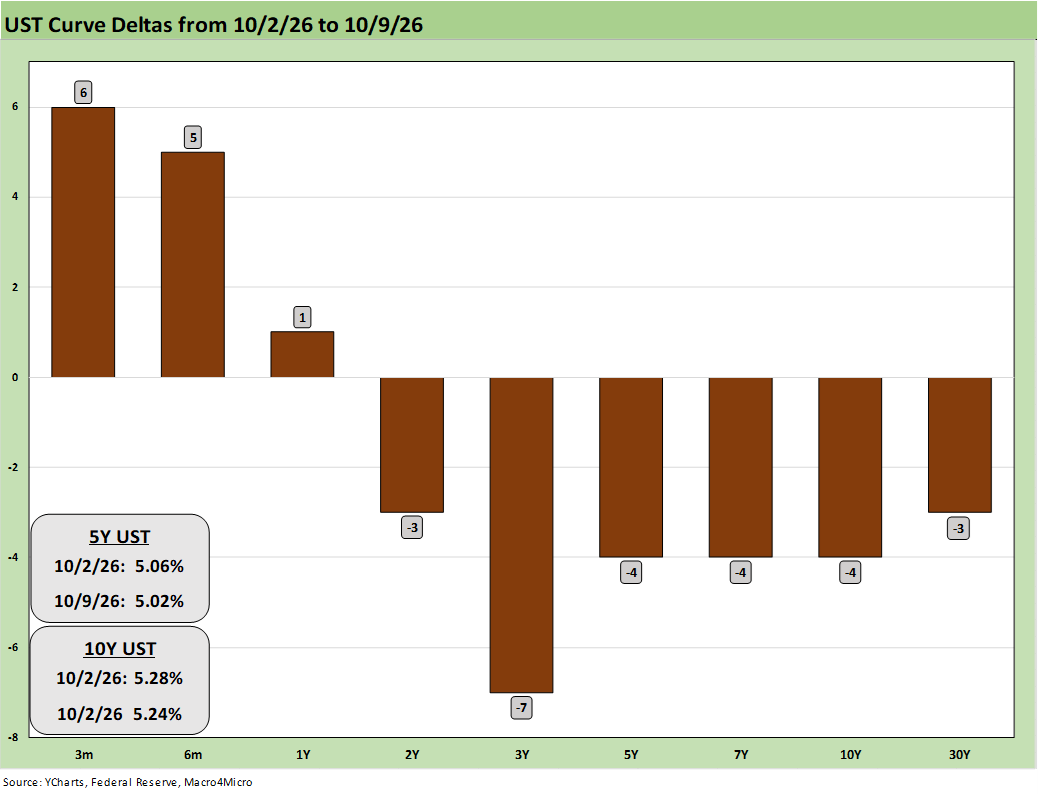
The chart updates the weekly UST yield curve deltas in what was a modestly positive week for duration despite the series of “highest since” headlines around 10Y and 30Y UST yields as the week unfolded. The10Y moved north to the 5.35% area before settling in at 5.24% as we go to print. As we will cover in separate commentaries, the 7 bond ETFs we monitor were all positive on the week.
With the FOMC minutes more benign than feared, the markets will await CPI and PPI this week for a fresh set of data at the headline level, core, and in key product segments near and dear to many households.
Mortgage rates saw the Freddie benchmark move to 7.4% while the more diverse and timely Mortgage News Daily survey ended the week at 7.48% after recently hovering near 7.6%. For some context, the move by Freddie to 7.4% is up from 7.28% the prior week and 6.3% YoY. The Freddie move to 7.4% is notable since the 10Y UST today is above where it was back during the cyclical peak in the Freddie rate in Oct 2023, when Freddie reached 7.63% with a 10Y UST just under 5% (see Mortgage Creep Continues, Curve Shapeshifting Uncertain 10-4-26). That leaves current mortgage rates exposed.
With the FOMC meeting this month, recent inputs have sent the odds of a tightening plunging at CME FedWatch to only 17.7% and one hike by the December meeting at 67.6%. Oil in the US (WTI) saw price action milder this week despite the usual toxic geopolitical headlines. The “annihilation, etc.” threats have dulled market senses (“call me when the mushroom cloud arrives”). That said, Iran is not backing down, and there is no easy offramp outside of common sense, which never outweighs Trump’s ego.
This week will see PPI and CPI, but we will also get releases on Existing Home Sales and Industrial Production. We can get a sense of how stalled housing sales volume remains with even more pressure on the “golden handcuff” mortgage refinancing barriers. We get a fresh read on the working capital cycles and how rising costs from tariffs, energy, materials and freight/logistics are flowing into pricing, costs, or tariff mitigation strategies. A major earnings wave arrives.
Inflation as a recurring price factor is just one aspect of the challenge in addition to inflation well above target (see CPI Aug 2026: Staying Stubborn, Not Accelerating 9-11-26, PPI August 2026: Leading Indicator Signaling Struggling 9-10-26) There is the “household basket” affordability issue that includes the one-time increases and the slow lag effects of tariff cost pressures. Those elements will get more visibility during 3Q26 earnings season as the myriad parts of costs (notably tariffs, energy, materials, freight) get balanced into a margin performance and outlook.