

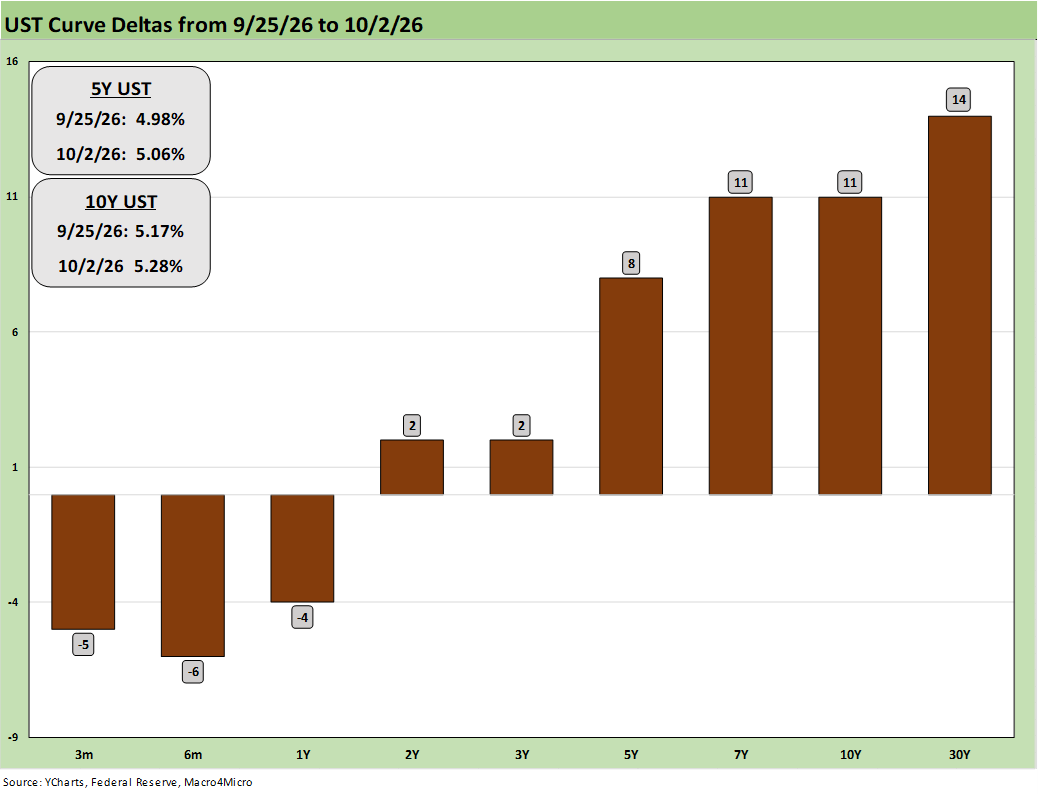
The past week saw a radically overhauled handicapping of the market odds on the timing of FOMC tightening. In broader context, the UST yield curve pressure initially appeared to get some light relief with a weak payroll release. That did not last.
After a very challenged stretch of stubborn inflation, adverse energy market dynamics and an apparent firming of cyclical fundamentals with 2Q26 GDP and PCE outlays, there seemed to be little to push back on UST bears (see Macro Dance-Off: PCE Growth vs. Fixed Investment 10-1-26, GDP 2Q26: Bullish Final Revisions 9-30-26). PCE inflation numbers were not bad, but they remain well above target (see PCE August 2026: Income & Outlays Show Firm Demand 10-1-26).
Payroll numbers brought a very weak reading of +29K (see Payroll Adds/Declines Sept 2026: Negative Revisions, Weak Payroll 10-2-26). The steep negative revisions of -60K for August and July also supported the plunge in FedWatch odds on the potential for an October tightening. That briefly caused some UST curve excitement that soon faded with the 10Y ending higher on the day after a brief rally.
The 2Y UST delta was muted as the odds of an FOMC hike to 400-425 at the October meeting declined to 22.1% per CME FedWatch as we go to print. That was down from 64.2% 1 week ago. For the Dec 2025 FOMC meeting, the odds of a 425-450 level have plunged to 17.9% from 51.0%. The odds of 400-425 by December meeting are now 67.1%.
The wildcard in the forecasts besides CPI and PCE inflation readings is of course Middle East geopolitics. Trump’s recent statements that oil would plunge after the election and that he would bomb Iran (or annihilate Iran) is a challenge to reconcile in tandem when another aircraft carrier and more troops are heading that way. The promise to deliver $5,000 checks also could make the UST supply issue a challenge to ignore and especially if there is also a fresh round of escalation along with it.