

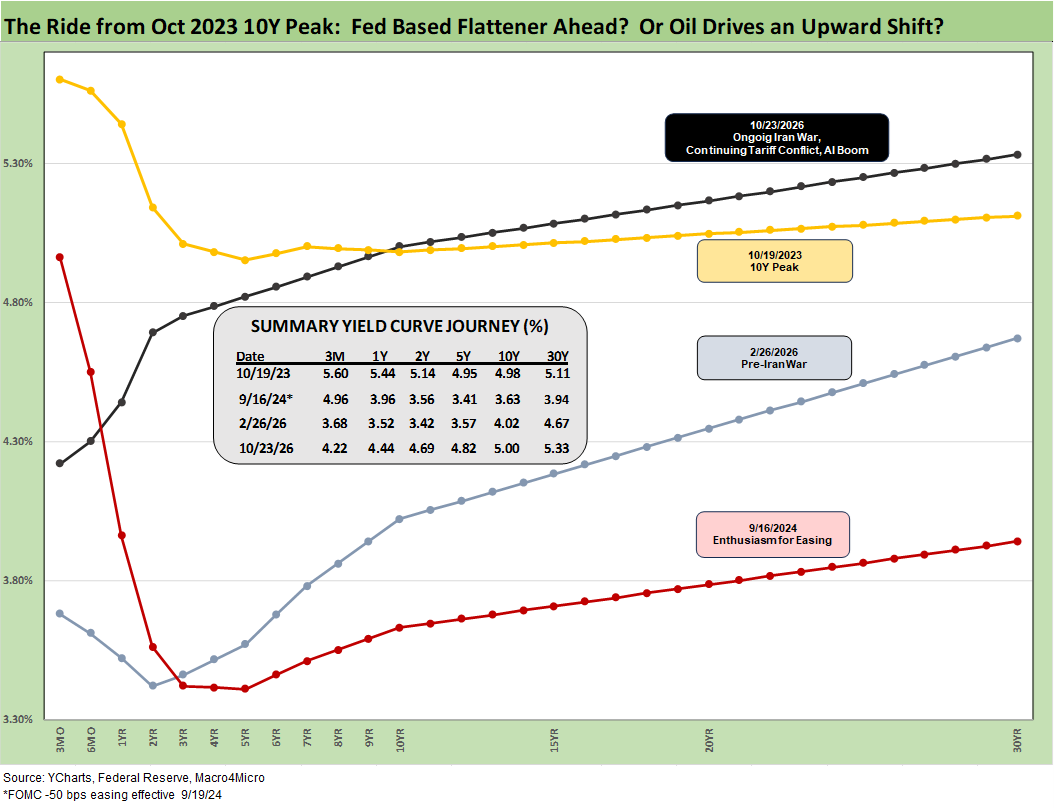
The above chart updates the UST migration patterns that we update periodically as a visual memory jogger. The easing cycle was just about to flow into the market in mid-Sept 2024. We include the 9-16-24 curve as a pre-easing frame of reference just ahead of the FOMC meeting and 2024 election. We also include the pre-Iran UST curve (bombing started 2-28-26) and the Friday curve 10-23-26.
We include the 10-19-23 curve as a frame of reference since that was when the Freddie Mac 30Y mortgage rate hit 7.63% with the 10Y UST closing slightly under the 5.0% line. That period also saw some 8% mortgage rates in surveys outside of Freddie (Mortgage Creep Continues, Curve Shapeshifting Uncertain 10-4-26, Mortgage Rates vs. UST Curves: Spooky Memories to Ponder 9-20-26).
The main takeaway from the UST trends captured in the chart is that the cost of financing has moved sharply higher since late 2024 despite multiple easing moves in 4Q24. We don’t expect Team Trump (Bessent, Hassett, et al) to cite how much higher rates are now since 4Q24. They will just blame Biden.
The transition from tightening into easing across 2023 and into 2024 was a wild ride (see Footnotes & Flashbacks: State of Yields 12-29-24). Today, the market faces a mix of inflation pressure with an FOMC determined to move the needle closer to 2% (at least they say they are). A crack in AI valuations combined with higher inflation and sustained high oil prices is just one of many scenarios one can spin.
A big question is how the new Fed regime would trade off equity market volatility and a correction and/or bear market tied to a ”bubble shock.” Would that detour the FOMC from the inflation commitment? You know Trump would be screaming bloody murder for lower rates if AI cracked.
The question is whether a scenario of AI bubble downside would drive Team Warsh to a Greenspan-style flashback to 2001 or the early 1990s as the Fed sought to cushion the blow (see Greenspan’s Last Hurrah: His Wild Finish Before the Crisis 10-30-22, UST Moves: The 1990-1991 Risk Factor Pig Pile10-24-23). The idea was mega-easing would relieve stock market pressures on the consumer sector and bring systemic relief to some troubled banks at the time. The rising credit risk today and likely spike in hedging exposure will raise some “old but new” issues. Warsh will have more trouble getting the votes than Greenspan did.