

Time for the White House to brush up on history?
The AI multiplier effects show up across the US macro landscape from the stock markets to record capex and fixed investment in the GDP accounts. As a result, Taiwan has been touted as the key to sustaining the macro, market and tech momentum for clearly evident reasons (see Wall Street OpEd this past week Taiwan Is the Key to AI Dominance 5-13-26).
“China week” and Trump’s trip did not go well for markets and notably the UST curve. WTI spiked by $10, and some energy trade rags were pointing at the China trip as a major contributor. Trump being off in China took some focus off Iran, but the clock keeps ticking on the oil supply crisis with this brutal stalemate. You can’t fight the supply factor and the clock. Time is not on anyone’s side at this point.
The already massive trade deficit with Taiwan is soaring in 2026 along with imports, so there is a remote probability that Trump might even learn that trade deficits can be good at times. Through March, Taiwan moved ahead of the EU and Mexico on the top trade deficit rankings after being #5 for 2025 (see US-Taiwan Trade: Risks Behind the Curtain 2-1-26, Trade Deficits: Math Challenge1-30-26). Through 1Q26, the trade deficit with Taiwan is up to -$52.9 bn vs. -$22.4 bn in 1Q25.
Taiwan has blown past China also in 1Q26 in the trade deficit rankings, so the combined Taiwan + China trade deficit will be other worldly. The demand is real for what Taiwan supplies, so that is in fact good news for the US economy and stock market (someone inform Trump please).
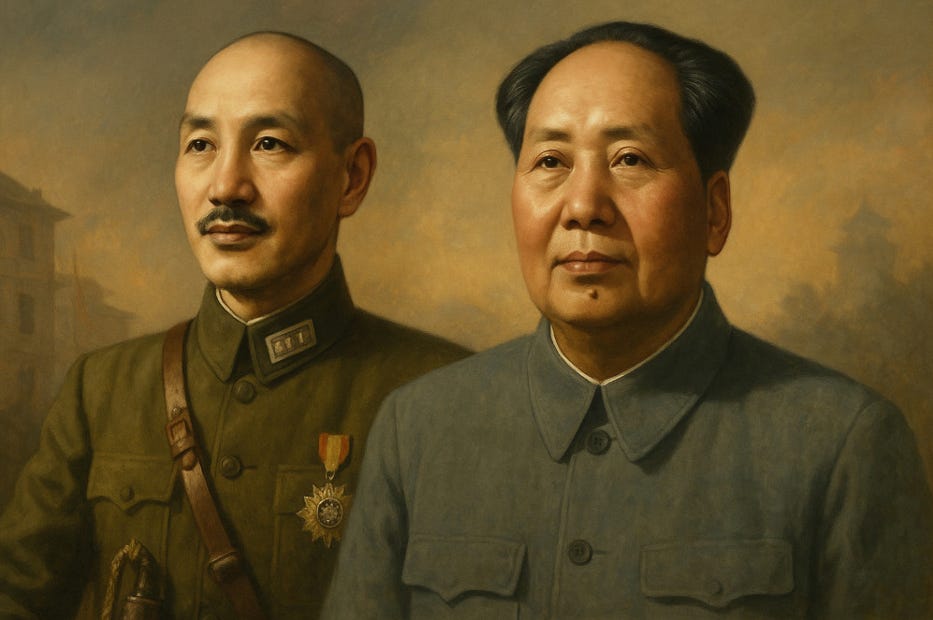
On the short list of things that will “never happen” is Trump reading up on the history of Chiang, Mao, the Chinese revolution, the exodus to Taiwan, and how the various Presidents have operated in this area. The less said by Trump the better given the massive stock market stakes, macro risks, and, under some scenarios, the very real risk of war with China. The paths to such setbacks are easily identifiable – sort of like Iran closing the Strait of Hormuz. It is hard to take anything for granted these days.
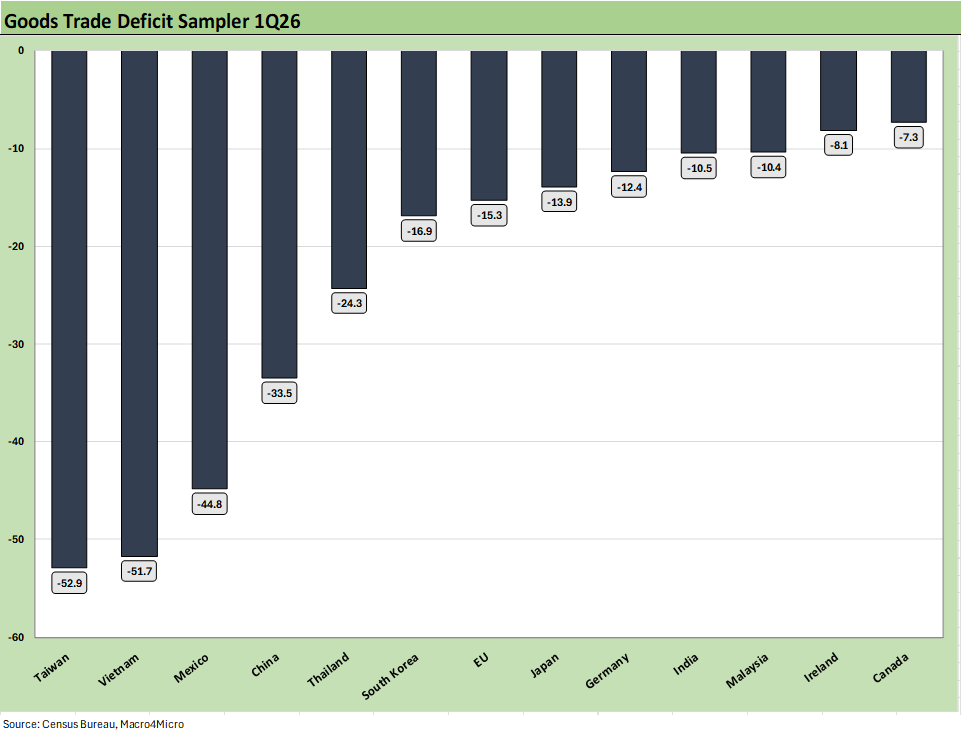
We break out a mix of trade deficit statistics above for 1Q26 with Taiwan now taking the lead. Taiwan’s deficit is now ahead of major trade partners such as the EU and Mexico. Vietnam is ahead of those also, but we are locking in on the Taiwan story and how its near doubling of imports YTD has a story to tell about the increasingly critical relationship between Taiwan imports and the strength of the securities markets and fixed investment component of GDP (see 1Q26 GDP Advance Estimate: Consumer Fade, Investment Boom 4-30-26).
The need to recognize the importance of Taiwan as a trade partner and tenuous geopolitical challenge should go without saying, but the White House has not been conceptually or factually sound in how it looks at trade deficits. We will not beat that dead horse again here (see Trade Deficits: Math Challenge 1-30-26, Tariffs: Questions to Ponder, Part 1 2-2-25, The Trade Picture: Facts to Respect, Topics to Ponder 2-5-25). It would be reassuring to believe Trump might learn from this example.
We also highlight the low deficit of Canada in the chart as the USMCA review process is on the immediate horizon. That Canada-US goods deficit is a solid surplus if we back out oil imports from Canada.
The Taiwan challenge…
The best news from the trip to China is that Trump did not and would not speak on the subject of Taiwan in any detail (e.g. weapons sales). That was a victory. Given his versions of WWI and WWII, the chances that Trump knows a shred of anything about China-Taiwan-US history is low. That makes for very unfavorable diplomatic risk symmetry as we have seen regularly from the White House. Trump’s lovefest with dictators is not new, but many of the MAGA types in Congress have been rewired to hate China by Trump himself.
The odds of Trump knowing about the One China policy, the history with Nixon, the UN, Carter, or Reagan are in the “when pigs fly” probability range. We saw that in Trump 1.0, but these days Taiwan is the cornerstone of AI and its massive capex multiplier effects across the economy. The stakes are high, and the cost of saying the wrong thing with incorrect historical facts (as Trump has done once or twice) could be very high.
US, China, Taiwan and a very jaded history…
The issue of Taiwan has been a very hot topic since long before 1949 when Mao and his army won the Chinese civil war and drove Chiang Kai-shek off the mainland to Taiwan. The challenges of China fighting the Japanese and the behavior of Team Chiang vs. Team Mao was later tackled by historians in ways they we did not learn about in school during the Vietnam years. Revisionist history and declassification dug into the brutal details as never before.
Like most such histories, the emotions run high and bias is often crystallized. The darker side of truth gets people’s blood up when conventional historical themes get questioned. These are different times, however, with the President of the US backing Russia with minimal effort to course correct. As in the US, where the Civil War gets too wide a range of versions (especially from the current White House), self-serving interpretations are the norm.
China Lobby and “who lost China?”
Henry Luce (Time Magazine) and the rise of the “China Lobby” in the US brought much to absorb and act upon by both rational, ethical people in Washington (e.g. Truman) and irrational ethics-free scumbags (Senator Joe McCarthy). The Chinese revolution was an event for the ages that still resonates today. Even as former enemies (Germany, Japan) were quickly “forgiven” and became critical Cold War allies and trade partners, China policies were a constant struggle. Truman had to wade into Korea while later JFK and LBJ faced the Vietnam decision challenges that came with the rise of Communism.
The fact that the Korean War occurred shortly after the 1949 Mao victory in the civil war set the tone and began the great challenge (and misread) of how to counter the Asia revolutions. In the case of Korea, the shockingly incorrect views of MacArthur on what China would and could do in Korea has been an evolving part of American history.
The “China and Mao” are evil themes have been getting promoted in recent years by Trump and the GOP although that is not new. Disclosure: my father enlisted in the Marines out of high school to fight in Korea and still had the “high and tight” hair when I was high school reading history on Korea and Vietnam. I would not repeat the “new history” over dinner as Saigon fell in 1975.
A lack of historical perspective still pervades the history of Chiang in Taiwan (Google or ChatGPT “228 Massacre” of 1947 for some flavor). The government of Chiang and his party include almost 4 decades of martial law and political execution of local Taiwanese. In recent years, I made an acquaintance of a Taiwanese minister who opened that door of history for me. His grandfather was a political murder victim. It is always more complicated than the classroom cliff notes. Taiwan history tends to be a neglected topic.
Nixon to Carter evolution on China…
The later years of Nixon and Carter redefined the nature of America’s recognition of China and the “One China” policy. During the years of the China Lobby, the question of “Who lost China?” was a political blame game (only later was the question countered with, “Who said China was ours to lose?”). That was the start of using journalism and media to promote partisan history and reverse engineering of facts. We are back there now under Trump.
The biggest changes came in the 1970s under Nixon in 1971 with the UN and later with Carter. The short version is China became the UN member on the Security Council. The Chiang Nationalists were out. It got better from there for China. Opening up relations with the PRC took an ancestral redbaiter such as Nixon since he could not be labeled as a “commie pinko” during those days when Vietnam was slowly winding down as a fiasco.
Until 1971, the US did not recognize one of the most populated nations on earth - China (the PRC) – who fought a war against the US in Korea. That seemed to make them a nation to most European observers. The policy before Nixon was that China was not recognized and that in fact did not exist. China joined the nuclear bomb club in 1964, and that was going to assure recognition at some point.
Nixon initially supported dual representation at the UN, but the UN voted to make the PRC the sole China under the United Nations. The US had its hand basically forced by 1972:
The U.S. side declared: The United States acknowledges that all Chinese on either side of the Taiwan Strait maintain there is but one China and that Taiwan is a part of China. The United States Government does not challenge that position. It reaffirms its interest in a peaceful settlement of the Taiwan question by the Chinese themselves.
The “rapprochement” really started the ball rolling, and the withdrawal of formal recognition came in 1979 (note: Chiang died in 1975) when the US withdrew recognition of the Republic of China (Taiwan). The fact that Jimmy Carter made it all official in 1979 was in many ways already established in substance under Nixon and certainly at the UN.
The US recognizes One China unequivocally then and now. Reagan policy did not change the core policy, but the whole timeline is one of ambiguities in many areas (defense supply, etc.) except for one – there is one China.
History is an out-of-favor discipline in the current “whatever Trump says” backdrop
History courses are wrapped around the history of China and Taiwan, and legions of authors have published books and papers on the topic. Foreign policy wonks pour out literature. For a more current Taiwan focus, we recommend the book “Accidental State: The United States and the Making of Taiwan” authored by Hsiao-ting Lin.
For some reading material in the China lobby history and the ugly Cold War times, a good source that frames a rapidly changing approach to political journalism and debates over what makes for “historical facts” is the book, “The Publisher: Henry Luce and His American Century” by Alan Brinkley.
Another good one that tells a story of the decades leading up to WWII and clashes between US leaders and Chiang is, “Stillwell and the American Experience in China” by Barbara Tuchman. The criticism of Chiang’s policies before and during the war with Japan is not hard to find. Many say his priority was watching Mao more than the Japanese.
The main message is that such history is complex, the messages and opinions often conflict, and the decisionmakers play with the story lines to satisfy their own goals. Taiwan will be another one of these examples in 2026-2027. The main “fact” is that there is One China. So as the US goes on a Manifest Destiny bender with James Polk a hero to Trump hanging on his wall, that would appear to put the US in the spectator seats on Taiwan – even if it can be a noisy spectator. Trump talks of the “Donroe Doctrine” and annexations. That can set a bar – except the policy of One China is already set.
Asia a case study in mixed history…
The banning of expertise in the foreign policy circles of Washington these days could turn into another case of “working with less facts and less history” and reverse engineering policy from the top down and filling in the data and facts later. Or ignoring them entirely.
“Policy by tantrum” will not work. Even a casual reader of history hammers home that tantrums and threats don’t work on China. The Marines of the “Frozen Chosin” lore found out the hard way that MacArthur’s assumptions were very wrong (like Hegseth’s on Iran). He made a lot of threats, and some were quite extreme. So, Truman fired him.
The main point is some of the biggest mistakes in 20th century geopolitical history included fatal (literally for many) misreads of China and its moving parts. Those mistakes led to wars, domestic turmoil, and a complete misunderstanding of where to draw the line – and whether to draw the line. The Filipino-American War, Korea, and Vietnam included a lot of cultural ignorance, dubious facts and evidence, and limited appreciation for nationalism.
Taiwan is the most important US trade partner on earth right now…
The relevance now is that Taiwan also holds the key to the US technology revolution. As noted above, the trade deficit is going off the charts – in a good way – and is likely to accelerate. Taiwan is not for the US “to lose” any more than China was for Truman to lose. Those are stories for other days.
Picking on Cuba and Venezuela while threatening Greenland is very different than China and its long-established embrace by the US of the One China policy. Similarly, bombing Iran is much different than a land invasion.
Trump is getting schooled right now in seeing the scenarios. Fortunately, Trump has an inexperienced Fox News host and religious zealot to help him through it. The macro risks of that Iran “excursion” are already evident. Now imagine a blockade of Taiwan and a full-blown China trade war that lasts for many months.
Iran has been a bad enough misread on the risks. A China clash would be crippling economically. Even if you win, the Taiwan economy would not be rescued by the US and the tech chain would be broken. Lose-Lose.
Taiwan by itself is deeply divided on some of the issues to be addressed ahead. See Brookings: How do Taiwanese feel about the Cheng-Xi meeting? 5-8-26 and Chinese citizens’ affection for Taiwanese may reduce risk of cross-Strait conflict 12-18-25.
There is zero chance of everyone being satisfied with a Taiwan policy that meets the One China rule.
Trump is abandoning the seat of American leadership, trading Taiwan for political favors (read; foreign influence), just like he did Hong Kong, while he prepares the Fed to destroy the Dollar and The One Big Beautiful Bill Act (TOBBBA) is set to kick-in next year with Economy collapse destruction of the People's Government *after the Election* in November.
He’s terrified of prison and a traitorous trader upon the American People of this Republic and the Free World, who must be stopped, else the blood with cover our hands and collectively shared futures, that are otherwise unlimited.
Though the Council that manages Xi Jinping is part of the same may be part of the same ethnic group, and if so, it should be OK. We're all Independently Sovereign republicans and Free (Self) Governing democrats, but Trump is a moron. I’m more worried about Korea and the PCBs leaking from the North into the Ocean killing our Ocas, which could very well collapse the food chain on Land AND in the Waters.
We, the People possess the the Original and Supreme, Legal Right to do it Peacefully. Join us as we men Gather with the "Other Half" of our Republic's Power: Women!
#savetheorcas #reuinitekorea #seasofairs #onerepublic
Enforests of Nature's Design:
https://republia.substack.com/p/native-coequality-is-natural-law-6ef