

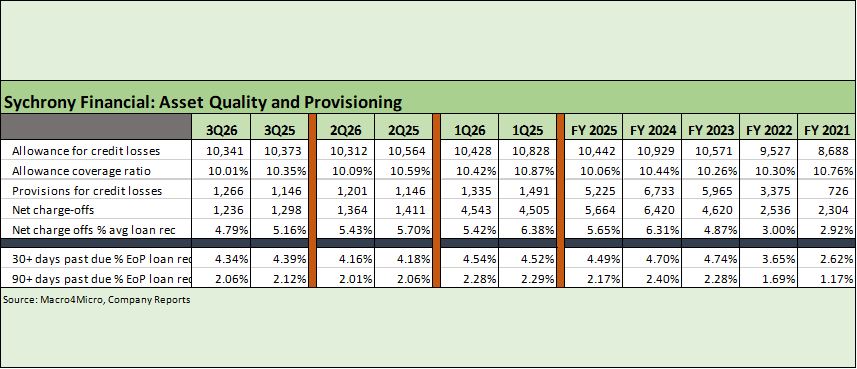
While there is no shortage of consumer finance operators to monitor from captive finance auto names to the major consumer lenders (Capital One, Ally, etc.) we like to watch Synchrony (SYF) for its breadth of lending markets and business partners along with 68 million accounts. We see very stable asset quality in the 3Q26 numbers above. While not shown, we saw relative stability in Cap One and Ally also. That is supportive news given the fact that the consumer sector has mounted a comeback in 2026 after a slow start for PCE Growth along the GDP lines (see GDP 2Q26: Bullish Final Revisions 9-30-26).
We have published detailed commentaries on SYF in the past, so we don’t need to revisit all the reasons we see it as a great proxy (see Synchrony: Consumer Bellwether Reassures on Quality 7-23-26, Synchrony: Credit Card Bellwether 10-30-25). The wide range of platforms and commercial partners across so many markets give a very wide angle on consumer spending. The very high net interest margins and high provisioning also make SYF a distinctive name.
Economies march into battle on credit, and the consumer side is holding up. Meanwhile, the AI ecosystem is becoming a case study in credit expansion to fund capex and investment. That includes debt and leases.
The front-loaded financial sector earning reports allow the market to check out bellwether names in consumer finance (notably credit cards and installment loans). Asset quality trends can be monitored for vulnerability of the consumer sector and how that flows into GDP along the PCE growth line that comprises around 68% of GDP. Subprime monitoring is a different exercise than the SYF credit card drill.
For 3Q26, looking at consumer asset quality credit metrics helps. The same is true for interest margins in a market where the UST curve has been unfriendly. The 15% handle interest margins on SYF remain steady with charge-offs in the 5% area holding.
The good news is that the numbers so far from Synchrony to Cap One to Ally are not sending alarming signals. With inflation higher, affordability strained, and the savings rate low in context (see monthly PCE releases), the cyclical news is constructive. There is every reason to watch how households are spending and gauge their ability to pay it back and/or keep spending (see PCE August 2026: Income & Outlays Show Firm Demand10-1-26).