

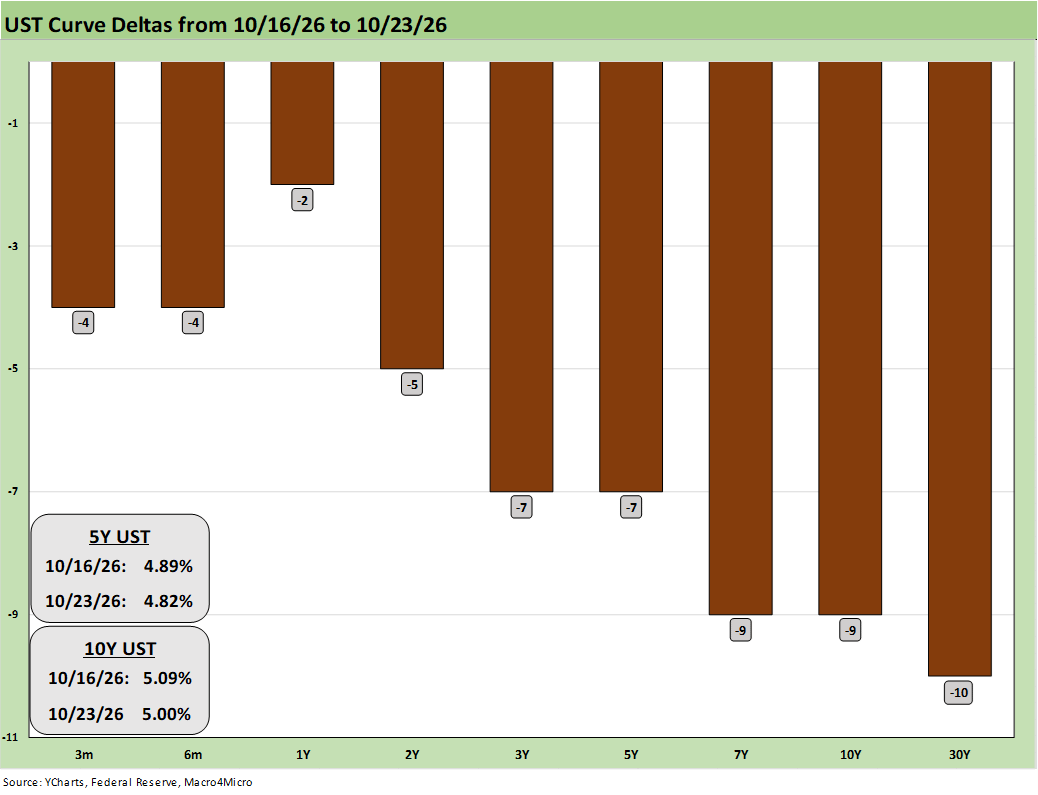
After the prior week’s material bull flattener, we saw another this past week. The chart details UST deltas for the week as a fresh UST rally came despite oil (WTI) at $103 and rising CPI and PPI printed the week before. For now, the inflation angst is taking a backseat to equity defensiveness and sector rotation.
The price action for 10Y UST across Wed/Thurs saw moves from around 5.15% down to near 4.95% before ending Friday at 4.99%. We recently crossed the 5.3% line.
For this past week, the 2Y was -5 bps, the 10Y -9 bps, and the 30Y -10 bps. The prior week, the 2Y was -6 bps, the 10Y -15 bps, and the 30Y -17 bps. That was set against grim PPI numbers and unfavorable CPI releases (see Weekly UST Deltas: Bear Macro but Bull UST Move 10-18-26).
As we already covered in our weekly asset return recap, the bond ETFs were all positive this week. The odds of a hike in the upcoming FOMC meeting were down to 10% as we headed into the weekend. The Dec FOMC meeting shows odds of 400-425 bps at 68.9% while 425-450 bps odds are down to 7.3% from 51% 1 month ago.
Subject to how the AI mini-panic frames up in earnings season, that could leave room for more UST steepening again if oil stays ugly with the US-Iran escalation rhetoric and if the PCE inflation metrics come in hot. The lag effects of tariffs and new trade stress ahead seem to have fallen down the headline priority list with the sheer weight of AI fears.
There is also the risk that the US election turns into a bigger sociopolitical fiasco than the nightmare base case of widespread election rejection. That is a laundry list for another day.
For bonds, the higher real yields are a selling point in narrow context, but inflation is not going away as a wildcard. We get the PCE release this week, and that will shed some more light on inflation metrics in the sector trenches.
The PCE release will bring a more granular look at income and outlays and whether the consumer is outspending income and drawing down savings rates. We also get the advance estimate on 3Q26 GDP with the latest read on the critical growth line for personal consumption expenditure for 3Q26 and the PCE inflation rate for the quarter. Fixed asset investment has been critical, but PCE growth is still around 68% of GDP. That will be an important number coming just after the FOMC meeting.
Lower savings rates can be by choice (“never bet against the US consumer”) or by draining household savings. There is “dropping the credit card” by necessity to deal with higher costs (inflation across goods, services, health care premiums, at the pump, and to heat a home). Ford reports this week, and that brings another fresh look at an important consumer sector after GM’s recent report. Car buyer resilience has been impressive.