

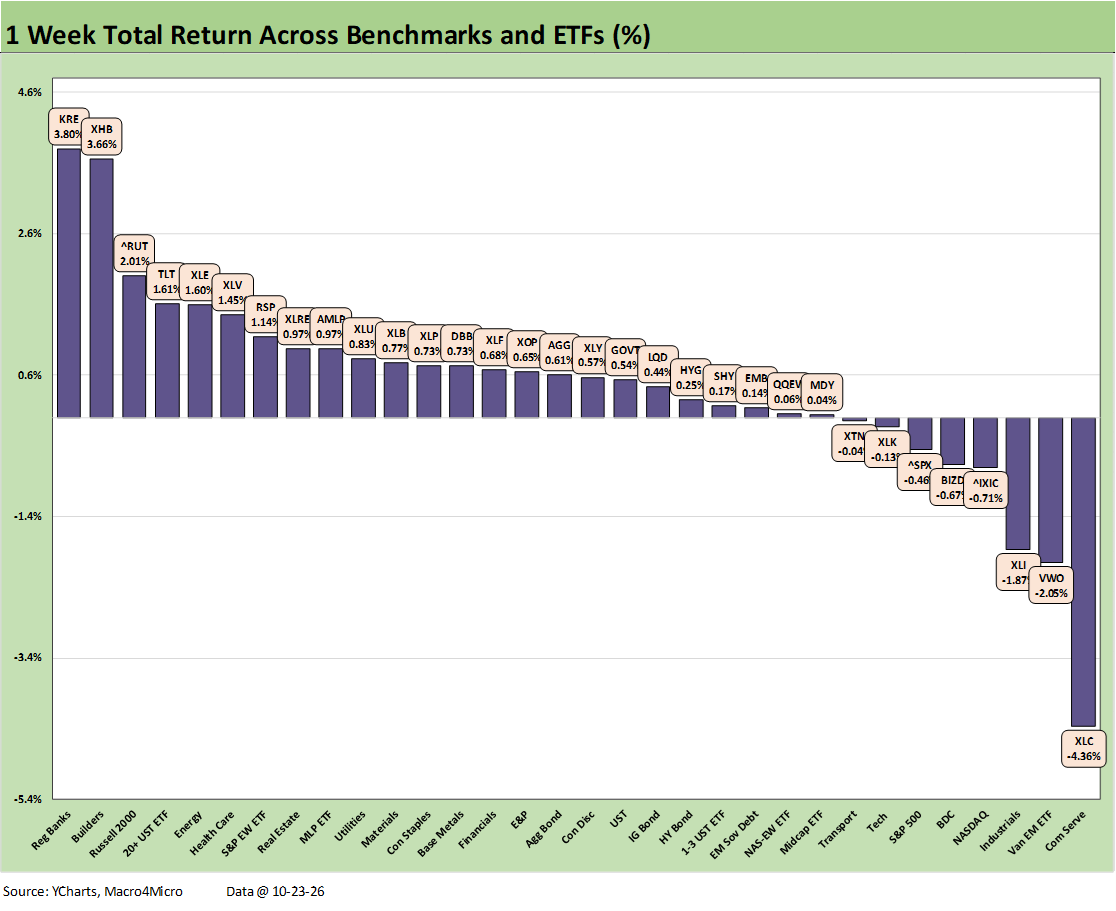
The chart details benchmark and ETF returns with a 24-8 positive-negative score for the week. The sharp UST rally was set against sustained high oil prices with WTI wrapping the week at $103. More critical macro color will be out this week even as AI jitters remain a theme.
The FOMC meets this coming week, and we get PCE inflation along with a first look at 3Q26 GDP. Fresh inputs on the growth lines (notably PCE and investment) could make the Fed’s life more challenging when combined with oil and recent CPI/PPI news. The odds of a hike in this week’s FOMC meeting were down to 10% as we headed into the weekend. The Dec FOMC meeting shows odds of 400-425 bps at 68.9% while 425-450 bps odds are down to 7.3% from 51% 1 month ago.
Earnings this coming week include Alphabet (GOOGL), Microsoft (MSFT), and Amazon (AMZN) along with GE Vernova (GEV) with its important input on power generation and ties to AI demand and data centers. We get a key consumer durables update with Ford Motor after GM’s earlier constructive release as autos, which have seen SAAR rates hold in well and shown resilience in the face of consumer headwinds (financing costs, affordability).
The UST rally gets tied to defensive flight-to-quality volumes as opposed to inflation and oil. The immediate practical effect was that all 7 bond ETFs posted positive returns for the week with the long duration UST (TLT) in the top quartile.
The top quartile shows the effects of lower UST rates as investors backed off from tech, chased UST, and firmed up demand in the most rate-sensitive sectors (XHB, XLRE). Energy (XLE) and defensive Health Care (XLV) made the top tier.
After a rough stretch, the Russell 2000 popped into the top quartile while the large cap S&P 500 and NASDAQ landed in the bottom quartile. The Equal Weight S&P 500 ETF (RSP) was notably in the top quartile with the tech heavy S&P 500 in the bottom tier. The Tech ETF (XLK) was in the bottom tier.
Communications Services (XLC) posted a poor performance in dead last. META and GOOGL sold off with AI anxiety and worries around recurring capex demands. Borrowing needs tie back into the assumptions on “how much, how soon” around AI-related cash flow levels and balance sheet demands (on or off the company balance sheet).
“Credit” is a word showing up in valuation debates more often while loan/lease commitments expand, counterparty “credit lines” rise, and “interconnectedness risk” increases across the system. Favorable bank earnings and steady asset quality metrics help with some background noise around commercial real estate quality. Commercial and Industrial lending was solid. The Regional Bank ETF (KRE) posted at #1 this week.