


What MAGA sees.
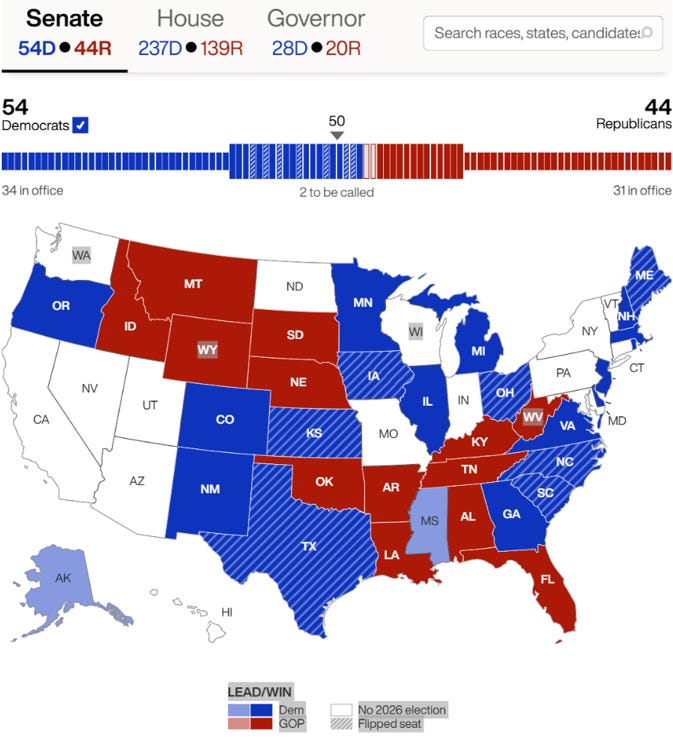
What the rest of voters see. (House up to 240D)
The election outliers made for wild headlines you seldom see across the decades, but we would put the Mississippi (MS) results at the top of the list even if the Democrats do not end up carrying MS in the end. For those of us watching elections on TV in the 1960s (notably 1968), the performance in 2 of the 5 “Wallace states” stand out as Mississippi and Georgia had diverged over the years. MS is harder to explain in 2026.
The fact that the stock market soared today “despite” a Democratic win offers evidence of the relief that a constitutional crisis did not unfold. The GOP was beaten so badly, Trump lacked the room to scream fraud.
Many of the Trump policies have been quite damaging including Iran, tariffs, inflation, ally estrangement, Russia bonding, and a budget deficit that may be too late to pare back in any meaningful fashion.
Mike Johnson is backing out, so the personality dramas on the GOP side will be interesting as the Democrats fashion a game plan that focuses on affordability, trade, and health care issues to start.
The data center risks and AI fallout will be on the front burner for the market.
Below we offer our views on some of the stranger developments in the election.
Senate and House controlled by Democrats: The media and political analysts are analyzing the results in rigorous fashion, so we will not do much of that here. The Democrats now control the purse strings in the House and the appointments in the Senate. That is no small deal. We await the final score on Mississippi and Alaska, but the closer Democrats get to 60 seats from the current 54 (56 still a longer odds possibility), then only a handful of GOP crossovers would be needed to get past a filibuster. It would be easier (though still absurdly difficult) to get to a veto override with what may be a more “courageous” group of GOP Senators or even some House members who need to look ahead to 2028 after last night’s sobering flip count – even in heavily stacked gerrymandered districts.
Mississippi is in a dead heat: While South Carolina is a shock, Mississippi (MS) being in a virtual tie as of this morning is almost beyond comprehension. We have covered the ugly history of MS in the past (see Martin Luther King Jr.—MLK was a Fact, Not a Theory 1-15-24). MS ranks #1 in the Tuskegee “lynching league tables” (see Lynching by State) in a history that Trump seeks to ban at the Smithsonian or at least put up disclaimer signs. As of 1964 before the Voting Rights Act, MS saw black voter registration below 7%.
The history of the Klan in MS offers no bragging rights, and the period during my lifetime has found its way into many movies. Disenfranchisement laws after Reconstruction ended are also part of history in the late 1800s. Black voter turnout in Mississippi was 29% in 1888, 2% in 1892, and 0% in 1895. That makes a statement on the Jim Crow years.
Georgia continues to move beyond its jaded history: Georgia has been walking upright longer than Mississippi as Trump discovered in 2020 with Atlanta as a major economic hub. GA has a less racist mix of legacy voters as the generations turn. Trump screamed fraud in 2020 as we all know, and that led to criminal charges as he leaned on the Secretary of State to fix the numbers. The results in this election for Georgia add even more legitimacy to the 2020 vote. Georgia has a history that includes being #2 on that Tuskegee lynching list. Georgia is a new world now with a female black governor. Jon Ossoff slaughtered Mike Collins by 18 points.
Democrats were impressive in Texas with Musk’s $$$ missing the mark: Texas will get more of the economic risk focus even just based on data centers. A Democratic Senator and Democratic Governor are already kicking around investment handicapping on data centers and AI. With the Dow up by 1637 (+3.2%) as we go to print, +117 (+1.7%) on the S&P 500, and the NASDAQ at +391 (+1.5%), the market does not seem to be buying Trump’s call earlier this week for a stock market crash and great depression backdrop. Policy does not get made overnight and awaits the new term.
On Texas, that election outcome is on Trump since he stabbed John Cornyn in the back and went with a corrupt fellow traveler and sycophant. Cornyn would have won. Meanwhile, the new Governor is a female of Mexican descent (Trump’s ethnophobia and racist comments on Mexicans are not worth revisiting). Gina Hinojosa was a former labor and civil rights lawyer. The massive wave of Hispanic votes moving over to Democrats – with some 70+% point swings by district in South Texas – set the stage for a reassessment by those in Congress on the Hispanic support that helped Trump in 2024. Racism and xenophobia and violent masked thugs were not the best plan for Texas.
Trump reaction: The idea that any reality check would be forthcoming from Trump still rounds up to zero as highlighted by his unsurprising response after this catastrophic election (Rebuke? Beatdown? Embarrassment?).
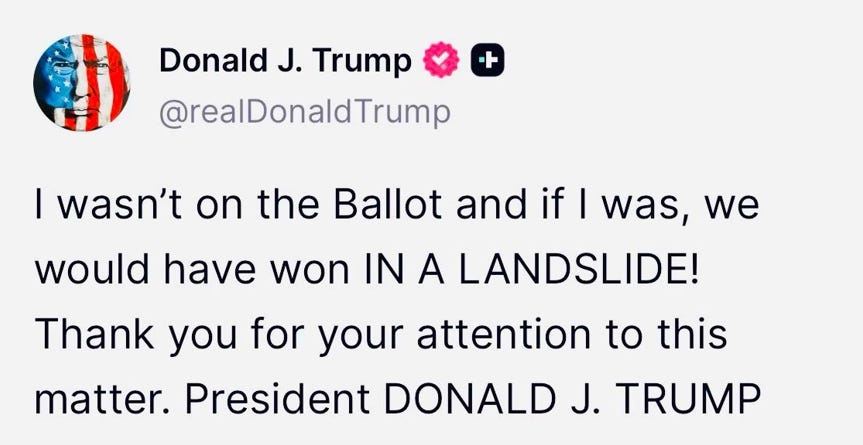
The bigger wildcard is whether this election defangs his ability to coerce GOP leaders in the House and Senate or at the state level. Those who need to position themselves for 2028 or run on a “courage ticket” in GOP primaries might be willing to get off the floor and stop lying prostrate before someone who has rejected years of GOP orthodoxy (Russia, tariffs, etc.). After all, Trump still thinks the “selling country” pays the tariffs. That makes him an economic ignoramus at best. Congress could consider charting a course tied to reality.
The ability of more GOP members of Congress to use real numbers vs. playing adjective-spouting bobbleheads (e.g. 2.8% annual GDP growth in 2024 dropped to 2.1% in 2025, CPI higher now than in Jan 2025, etc.) could bring some rational objective bipartisan discussions on what is working and not working. Screaming RINO and “Communists” might not be as scary to a credible person today vs. what it was 2 days ago. Threatening to primary someone might not work as well as confidence grows for individual members of the GOP. That might be too optimistic…but dare to dream.
Tariffs ripe for a challenge: The trade war on Canada would qualify as a topic ripe for a challenge to Trump that might get some in Congress to cross the line and “stand up” and legislate fresh checks on a rogue executive. Trump continues to abuse Section 232 (national security) tariffs and Smoot Hawley. Tariffs are run by the House, but Trump has been abusing and misusing obsolete legislation after SCOTUS killed IEEPA. Time for some new bipartisan legislation on the topic?
A lot has to play out as the new lineup in the Senate and House take their seats. The GOP needs to get their new leadership straight while the Democrats need to demonstrate they can actually lead on policy and not just engage in a retribution campaign. There are many doubters.