

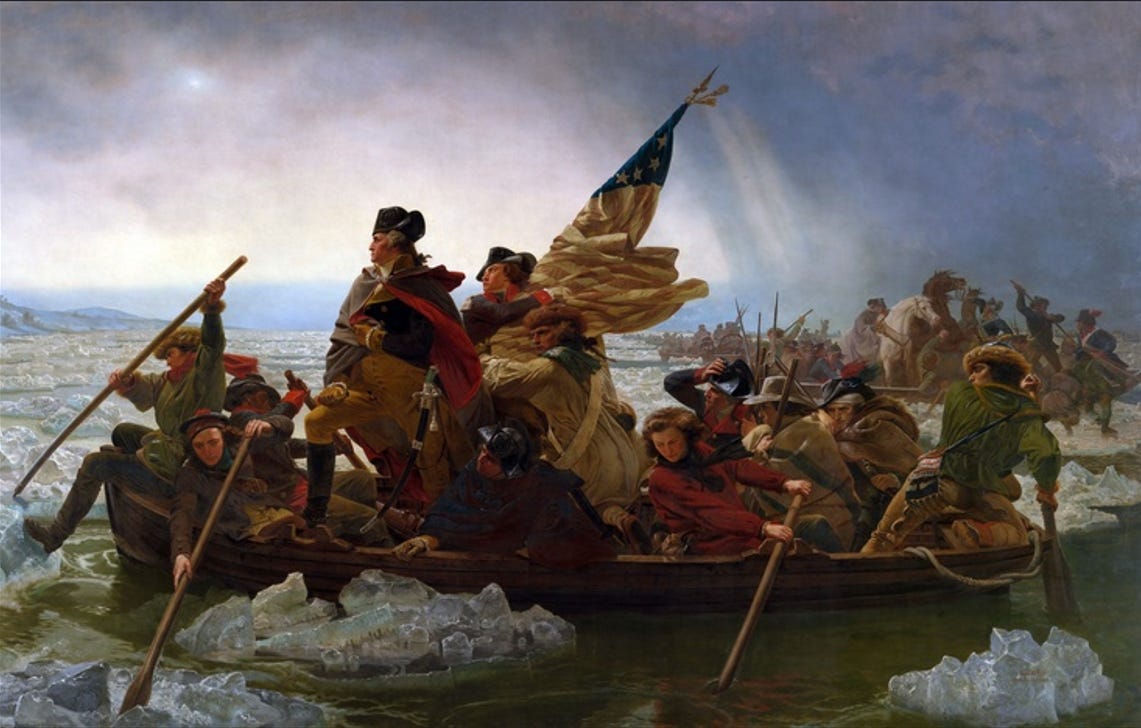
Nobody said this would be easy!
We cite the words of some Founding Fathers as food for thought in very troubling times. Warnings about tyrants and despots and the intrinsic threat of the power-hungry was the recurring theme. Freedom of religion and oppression via religion came up along the way (thus Christianity was not written into the Constitution despite many repeated efforts to inject it over many subsequent decades).
The worries around the damage that can be done by factions, political parties and individual groups seeking to concentrate power was something we learned about in elementary school and secondary school before we all joined parties, got opiniated, perhaps felt pressured by the church, started to ignore facts, and forgot what we knew.
With the exception of including Benjamin Franklin, we cite the first 4 Presidents. As a reminder, 3 of those 4 Presidents owned slaves and hailed from Virginia, which was later to be one of the “Stars and Bars” confederate states. Adams was against slavery on moral grounds.
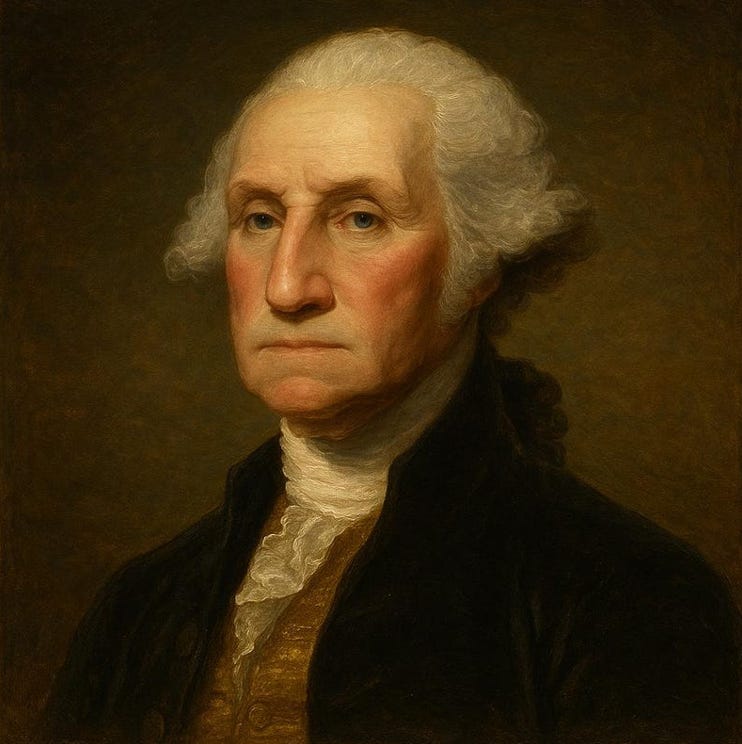
George Washington was renowned for his Farewell Address that signaled to the country his fears of what could happen to the President’s office if the power-hungry refused to push away from the table to pass the mantle. These days, we cannot even get judicial appointees in hearings to admit Trump is limited to two terms under the post-FDR 22nd Amendment. George Washington was especially worried about partisanship and political parties being divisive. After all, two extreme parties can be bad (the current GOP and Democrats would agree with half of that).
A few notable quotes from Washington’s Farewell Address:
“The alternate domination of one faction over another, sharpened by the spirit of revenge, natural to party dissension, which in different ages and countries has perpetrated the most horrid enormities, is itself a frightful despotism. But this leads at length to a more formal and permanent despotism. The disorders and miseries which result gradually incline the minds of men to seek security and repose in the absolute power of an individual; and sooner or later the chief of some prevailing faction, more able or more fortunate than his competitors, turns this disposition to the purposes of his own elevation, on the ruins of public liberty…
…It is important, likewise, that the habits of thinking in a free country should inspire caution in those entrusted with its administration, to confine themselves within their respective constitutional spheres, avoiding in the exercise of the powers of one department to encroach upon another. The spirit of encroachment tends to consolidate the powers of all the departments in one, and thus to create, whatever the form of government, a real despotism. A just estimate of that love of power, and proneness to abuse it, which predominates in the human heart, is sufficient to satisfy us of the truth of this position.”
Note: Anything in here ring a bell in 2026? Checks and balances are MIA, SCOTUS was stacked in a process that was “rigged” (to use Trump’s favorite word), and some Cabinet members were picked to purge expertise and objectivity (notably Defense, DOJ, Intelligence) or go into quasi-liquidation mode (Education).
Where have you gone, George Washington? Our nation turns its lonely eyes to you…
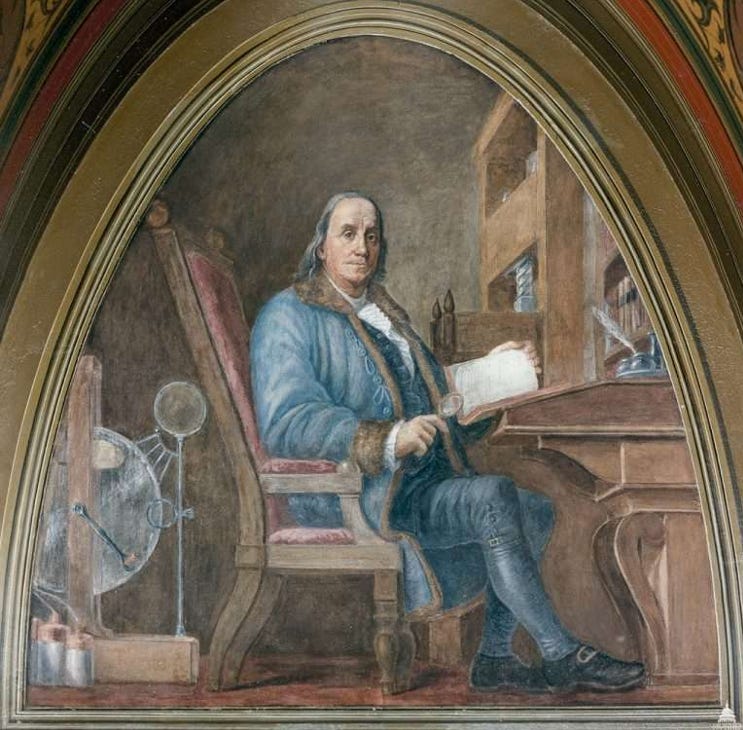
Some quotes to ponder from Benjamin Franklin—a man who does not need a memory jogger. Franklin had his fingers in a lot of pies including the Declaration of Independence, the Constitution, and foreign policy:
“Those who would give up essential liberty, to purchase a little temporary safety, deserve neither liberty nor safety.”
“Without freedom of thought there can be no such thing as wisdom; and no such thing as public liberty, without freedom of speech.”
“Sell not…liberty to purchase power.”
“Only a virtuous people are capable of freedom. As nations become more corrupt and vicious, they have more need of masters…”
“This Constitution…can only end in despotism…when the people shall become so corrupted as to need despotic government, being incapable of any other.”
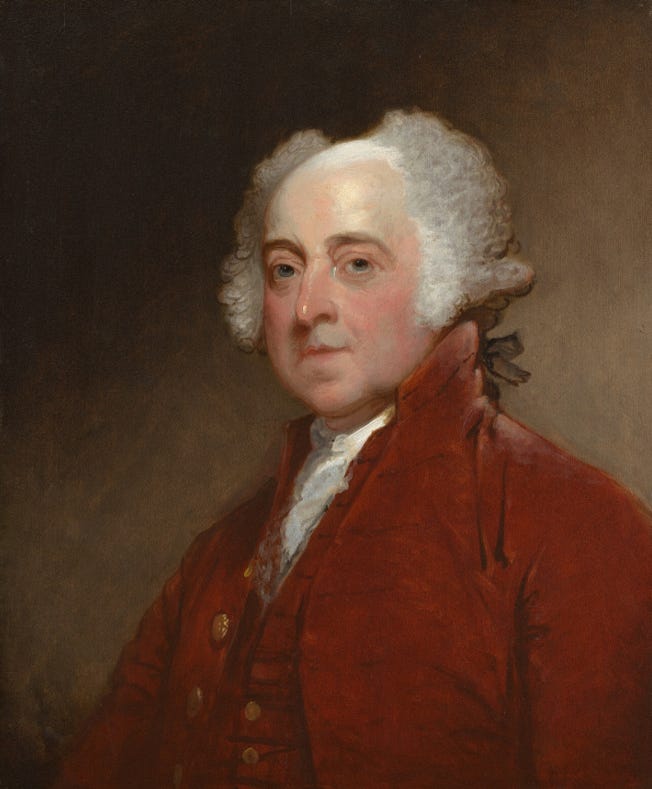
John Adams is an outlier in the original wave of Virgina Presidents as a Massachusetts “Harvard guy.” Virginia had the largest economy and most clout, but Adams snuck in as Washington’s Vice President before losing his run for a second term. He will always carry the taint of the Alien and Sedition Acts which in fact gives him a little more in common with Trump. Adams was an advocate of the separation of church and state. That is a distinction from Trump even if Adams was far more religious in practice and fact. Adams shared a common fear of despotism and oligarchy. His quote on “facts and evidence” below puts him on a different planet than Trump.
“When economic power became concentrated in a few hands, then political power flowed to those possessors and away from the citizens, ultimately resulting in an oligarchy or tyranny.”
“The fundamental Article of my political Creed is, that Despotism, or unlimited Sovereignty, or absolute Power is the same in a Majority of a popular Assembly, and Aristocratical Counsel, an Oligarchical Junto and a Single Emperor. Equally arbitrary cruel bloody and in every respect, diabolical.”
“Facts are stubborn things; and whatever may be our wishes, our inclinations, or the dictates of our passions, they cannot alter the state of facts and evidence.”
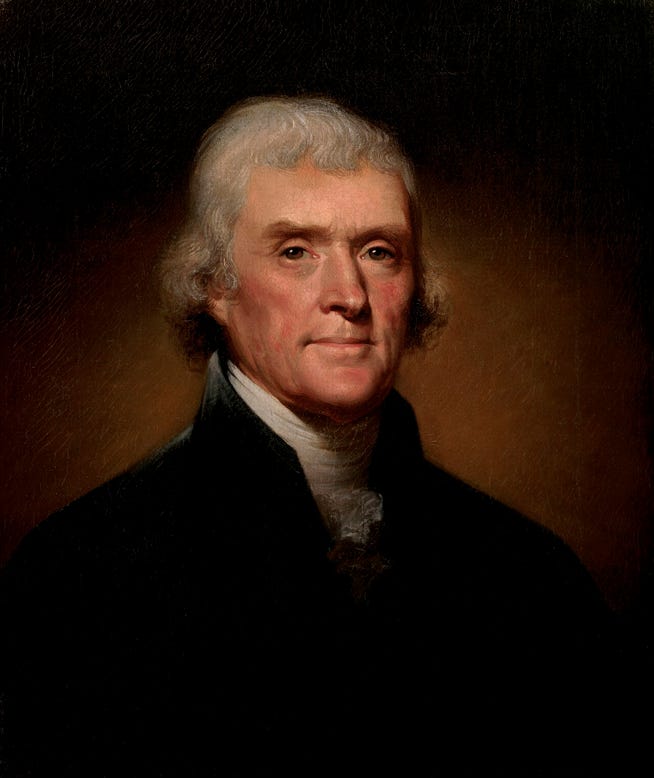
Thomas Jefferson was a legendary wordsmith and primary author of the Declaration of Independence, and no founding father distrusted centralized power more than he did. He was an advocate of freedom of the press (not “a thing” these days in Washington when broadcast licenses get threatened and Trump sues networks).
“Experience hath shewn, that even under the best forms of government those entrusted with power have, in time, and by slow operations, perverted it into tyranny.”
“I have sworn upon the altar of God, eternal hostility against every form of tyranny over the mind of man.”
“I have been ever opposed to the party, so falsely called federalists, because I believe them desirous of introducing, into our government, authorities hereditary or otherwise independent [sic] of the national will. These always consume the public contributions and oppress the people with labour & poverty.”
“Our liberty depends on the freedom of the press, and that cannot be limited without being lost.”
“Bigotry is the disease of ignorance, of morbid minds; enthusiasm of the free and buoyant. Education & free discussion are the antidotes of both.”
“I agree with you that it is the duty of every good citizen to use all the opportunities, which occur to him, for preserving documents relating to the history of our country.”
“Our particular principles of religion are a subject of accountability to our god alone. I enquire after no man’s and trouble none with mine; nor is it given to us in this life to know whether yours or mine, our friend’s or our foe’s, are exactly the right.”
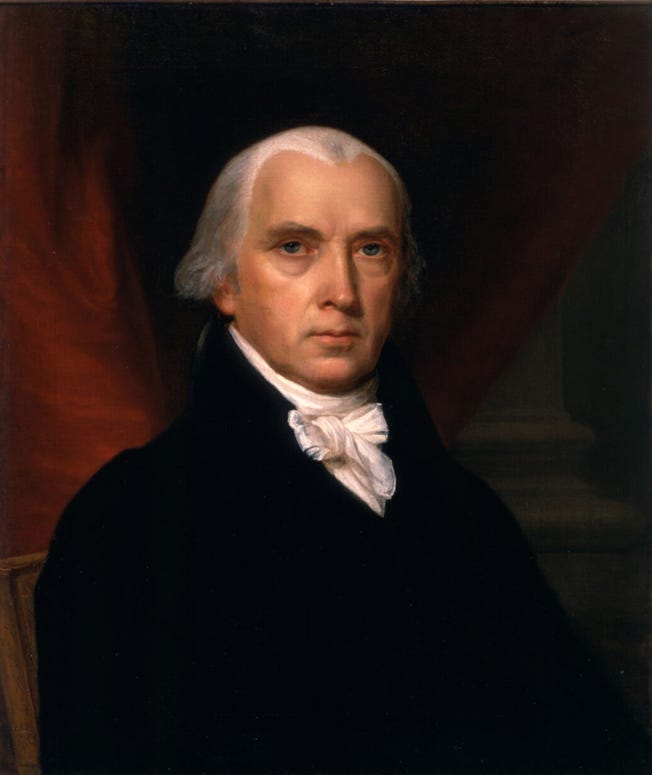
James Madison was one of the Federalist Papers authors (with Alexander Hamilton and John Jay). Madison was especially focused on factions. He also flagged the risks of war as a means of concentrating power and control. In today’s terms, if a leader suddenly turns into a proponent of war and use of military in contrast to his promises, that may raise some questions on what his motives might be. Sound familiar in 2025-2026. Military purges? Removing expertise from the foreign policy ranks to be replaced by inexperienced henchmen?
“The accumulation of all powers… in the same hands… may justly be pronounced the very definition of tyranny.”
“The strongest passions and most dangerous weaknesses of the human breast; ambition, avarice, vanity, the honorable or venal love of fame, are all in conspiracy against the desire and duty of peace.”
“If Tyranny and Oppression come to this land, it will be in the guise of fighting a foreign enemy. Of all the enemies to public liberty, war is, perhaps, the most to be dreaded because it comprises and develops the germ of every other... No nation could preserve its freedom in the midst of continual warfare.”
“War is the parent of armies; from these proceed debts and taxes; and armies, and debts, and taxes are the known instruments for bringing the many under the domination of the few.”