


You have any entry level homes? Beverly Hills 90210 is out of my price range.
We look at the comparative stock returns of the major public builders across a range of timelines. We leave out a few from our historical collection based on merger activity (Taylor Morrison, Tri Pointe) and takeovers in process (Dream Finder’s unsolicited bid for Beazer).
Berkshire’s acquisition of Taylor Morrison Homes for $8.5 bn in enterprise value ($6.8 bn equity value) offers a reminder of the strong free cash flow profiles of the major builders that BRK tends to favor.
The reporting season will shed some light on where builder selling prices are heading with monthly payments getting uglier and supply issues mixed by product tiers and regional markets. The price pressure has been downward from the builders reporting on ASPs, and those will be interesting to watch by region. The headline numbers in new Home Sales from the Census (due this week) come with the asterisks of region and price tier mix.
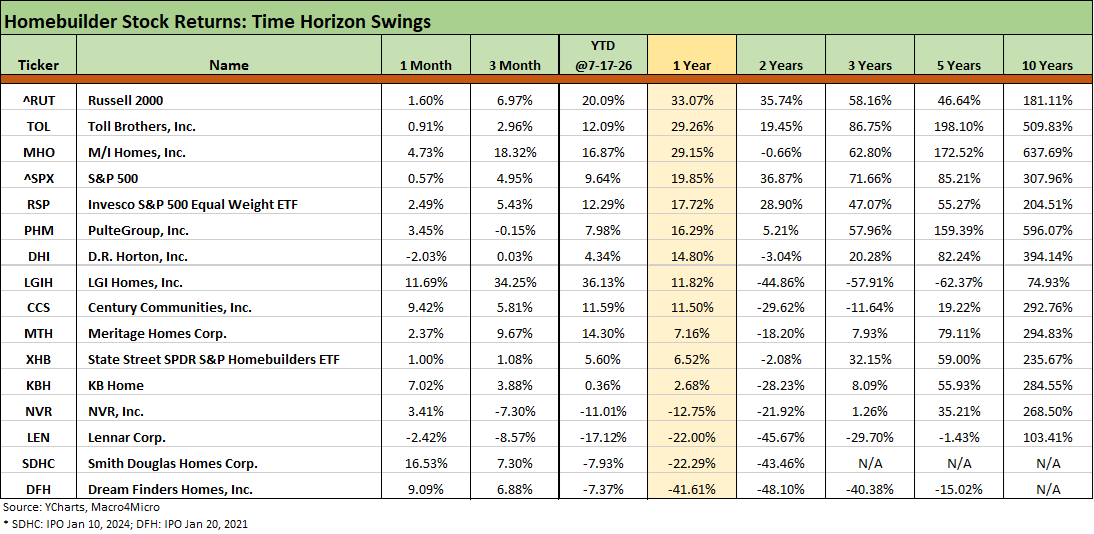
The table details the running timeline equity returns on a range of homebuilders. We also include some useful benchmark comps including the Homebuilder ETF (XHB), which includes suppliers.
We line the builders up in descending order of returns for the trailing 1-year period. Toll Brothers leading the pack is no surprise since their customer base is not sweating out mortgage approval or monthly payment pressures (see Toll Brothers Update: The Million Dollar Club Rolls On 8-26-25, Credit Snapshot: Toll Brothers 5-5-25, Toll Brothers: Rich Get Richer 12-12-24).
The regional builders look good (notably M/I) since that tier comes with a growth twist. Pulte Group offers some of the highest margins in the industry, so we will be interested in their numbers when they report this week given the pressure on selling prices and supply costs we hear about in the space (see Credit Snapshot: PulteGroup (PHM) 5-7-25).
On the other end of the spectrum in selling prices, D.R. Horton remains one of the best bellwethers to look at for multiple reasons even beyond its national scale as the largest builder and highest market cap (by far). DHI posts prices that are more in line with “normal people.” DHI is also in the build-to-rent business and is a majority-owner of a land/lot developer, Forestar, which has done well. The struggles of Lennar and NVR in performance over the past year are worth digging into against peers when all the reports are in.
Deals will continue…
The Taylor Morrison deal was a major headline as a top builder will get taken out of the public domain. We liked the company and the consolidation theme continues with more deals likely to unfold (see Credit Snapshot: Taylor Morrison Home Corp (TMHC) 4-2-25, Credit Crib Note: Taylor Morrison Home Corp (TMHC) 5-20-24). The TMHC operating strategy had been a success story with BRK retaining the management team.
We have seen major Japanese suppliers/builders making deals to integrate downstream into the US (Tri Pointe by Sumitomo. M.D.C. by Sekisui) and over the years plenty of intra-US builder acquisitions to broaden product tiers and geographic mix. Taylor Morrison made some transformational deals itself (e.g. William Lyon) on the way to Berkshire buying them.
“Taylor Morrison Home Corporation (NYSE: TMHC) and Berkshire Hathaway Inc. (NYSE: BRK.A; BRK.B) jointly announced today that they have reached a definitive agreement for Berkshire Hathaway to acquire Taylor Morrison for $72.50 per common share in cash, representing a total equity value for Taylor Morrison of approximately $6.8 billion and total enterprise value of approximately $8.5 billion. The acquisition price represents a 24% premium to Taylor Morrison’s latest closing price of $58.50 on May 29, 2026.”
The Beazer hostile takeover can be seen as another stage of the industry consolidation story that has played out across the past housing cycles. BZH is still working its way through the process:
“In connection with this work, on June 29, 2026, Beazer informed Dream Finders that it believed Dream Finders’ June 22, 2026, updated proposal to acquire the Company for $29.25 per share continued to significantly undervalue the Company and did not represent an appropriate basis for further discussion. In reaching this decision, Beazer’s Board was informed, in part, by the potential shareholder value represented by other proposals and Beazer’s current standalone strategy.”
“On June 30, 2026, Dream Finders raised the value of its proposal to $32.00 per share and relinquished its exclusivity requirement, but it refused to enter into a customary confidentiality and “standstill” agreement similar to those entered into by other parties. Instead, Dream Finders decided to make its latest proposal public in what can only be perceived as an attempt to pressure Beazer’s Board to engage with Dream Finders under unilateral terms that Beazer’s Board does not believe to be in the best interests of shareholders.”
There is a clear divergence in the builder equity performance, but the exceptional cash flow resiliency of the larger players mitigates credit risks.